
Understanding the Role of Mirror Neurons in Human Behavior
Mirror neurons, often cited but rarely studied in depth, play a crucial role in various human phenomena beyond empathy and learning. They are at the center of many other mysteries that continue to fascinate scientists and researchers alike.
What Are Mirror Neurons?
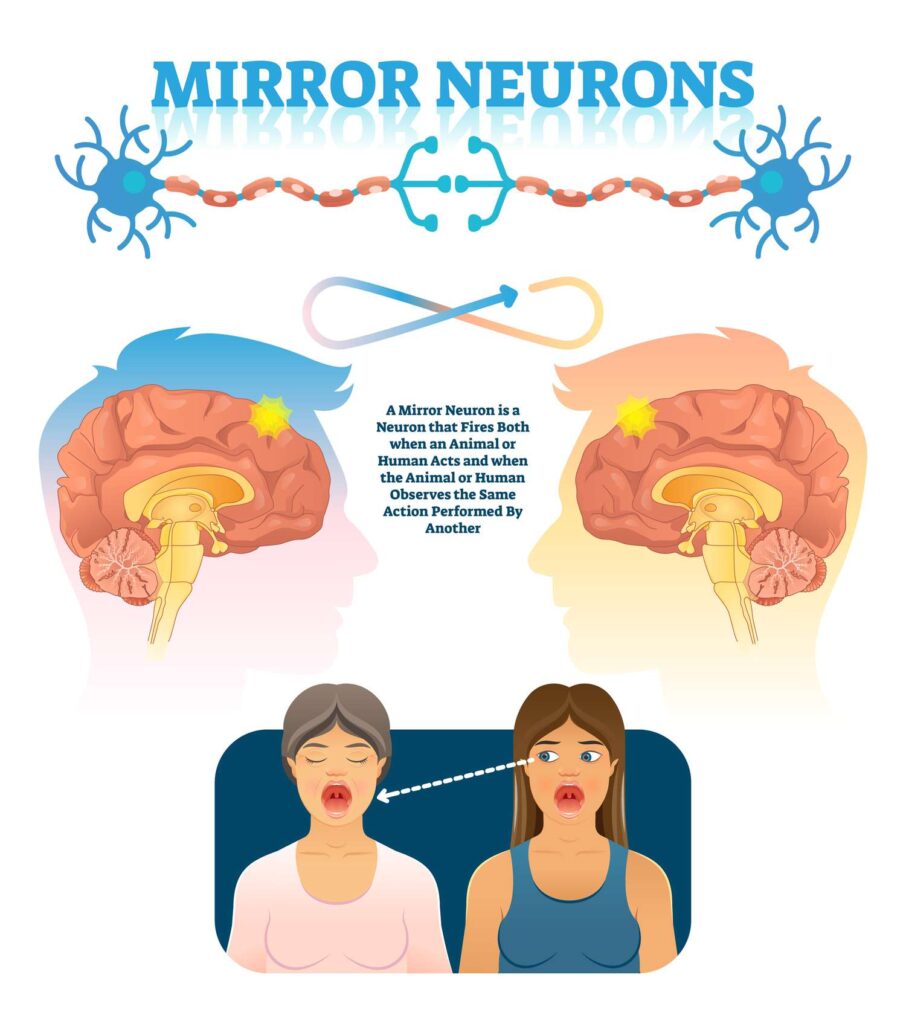
Mirror neurons are motor cells that fire when we observe someone performing an action. This is why we can immediately understand another person’s behavior, and it allows us to rapidly perceive our surroundings and empathize with others. These cells are responsible for our ability to learn through imitation, a key aspect of human development.
The concept of mirror neurons was first introduced by Giacomo Rizzolatti and his team in the 1990s while studying macaque monkeys. They observed that when these animals performed an action, such as grasping or reaching, their brain cells fired not only when they performed the action themselves but also when they observed others performing the same action.
This phenomenon was later confirmed in humans, where researchers found that similar mirror neuron activity occurs in the brain when we observe someone else performing an action. This is known as “mirror self-recognition,” which allows us to understand and empathize with others’ actions.
The Importance of Mirror Neurons in Human Emotions
When we observe someone experiencing a strong emotion, these neurons resonate with that feeling, allowing us to feel it too. For example, if we see someone laughing or crying, our mirror neurons fire, enabling us to understand and connect with their emotional state.
This complex relationship between mirror neurons and emotions is still not fully understood. However, research suggests that mirror neurons play a crucial role in empathy, understanding the emotional state of others, and learning processes through imitation.
Mirror Neurons and Autism
Some researchers believe that mirror neurons may partially explain certain forms of autism, such as Asperger’s syndrome. Studies have shown that individuals with this condition often exhibit reduced activity in their mirror neuron system.
However, mirror neurons also influence how we interact with others, beyond the realm of autism. They enable us to understand and respond to social cues, which is essential for building relationships and maintaining social connections.
The Psychology of Mirror Neurons
Many psychological phenomena can be attributed to the functioning of mirror neurons, which enable knowledge diffusion and learning processes. Humans differ from other primates in their ability to learn through imitation, largely due to the role of mirror neurons.
Observing a child or an animal’s learning process reveals significant differences in imitative abilities. For instance, children with autism often exhibit reduced imitative behaviors compared to their non-autistic peers.
Mirror Neurons and Language
In both humans and primates, there are areas of the brain associated with movement and perception that are also connected to language processing. Mirror neurons play a crucial role in these regions, influencing our ability to understand and produce language.
For example, when we observe someone speaking or gesturing, our mirror neurons fire, enabling us to comprehend their meaning and respond accordingly. This is why sign languages and other forms of non-verbal communication often rely on the use of gestures and visual cues.
The Book: “I Know What You Do” by Giacomo Rizzolatti and Corrado Sinigaglia
In their book “So quel che fai. Il cervello che agisce e i neuroni specchio”, Rizzolatti and Sinigaglia explain how mirror neurons influence our daily actions and emotions, often guiding us without us even realizing it.
This book is an excellent resource for both professionals and those curious about the psychological aspects of mirror neuron research. It provides a comprehensive overview of the role of mirror neurons in human behavior, from empathy to language processing.
Conclusion
Mirror neurons are a crucial part of human behavior, influencing our understanding of others, empathy, and learning processes. While there is still much to be discovered, research has shed light on their role in various phenomena, from autism to language processing.
Understanding the function of mirror neurons can help us better comprehend ourselves and others, leading to improved social interactions, communication, and overall well-being.
Frequently Asked Questions
- What are mirror neurons?
Mirror neurons are motor cells that fire when we observe someone performing an action, allowing us to rapidly perceive our surroundings and empathize with others. - How do mirror neurons influence human behavior?
Mirror neurons play a crucial role in empathy, understanding the emotional state of others, and learning processes through imitation. - Are mirror neurons responsible for autism?
While some research suggests that mirror neurons may partially explain certain forms of autism, their relationship with autism is complex and still not fully understood. - What is the role of mirror neurons in language processing?
Mirror neurons are involved in areas of the brain associated with movement and perception, influencing our ability to understand and produce language. - How do mirror neurons influence our emotions?
Mirror neurons resonate with feelings we observe, allowing us to feel them too, which plays a crucial role in empathy and understanding emotional states. - Can mirror neurons be studied in humans?
Yes, mirror neurons have been extensively studied in both humans and animals, providing valuable insights into human behavior and cognition. - What are the implications of mirror neuron research?
Understanding the role of mirror neurons has significant implications for fields such as psychology, neuroscience, and education, particularly in understanding human learning processes and social interactions. - Can mirror neurons be used to treat autism or other neurological disorders?
While there is promising research on using mirror neurons to develop new treatments for autism and other conditions, more studies are needed to fully understand their potential therapeutic applications.
Future Research Directions
- Neural basis of empathy: Further research is needed to understand the neural mechanisms underlying empathy and how mirror neurons contribute to this process.
- Mirror neuron systems in different brain regions: The role of mirror neurons in various brain regions, such as the premotor cortex and the insula, requires further investigation.
- Developmental changes in mirror neurons: Understanding how mirror neuron activity changes across the lifespan can provide insights into human development and learning processes.
- Clinical applications of mirror neurons: Developing new treatments for neurological disorders, such as autism and Alzheimer’s disease, based on the understanding of mirror neurons’ role in brain function is an exciting area of research.
By continuing to explore the complex relationships between mirror neurons, emotions, and behavior, we can gain a deeper understanding of human cognition and social interactions.


