
Introduction
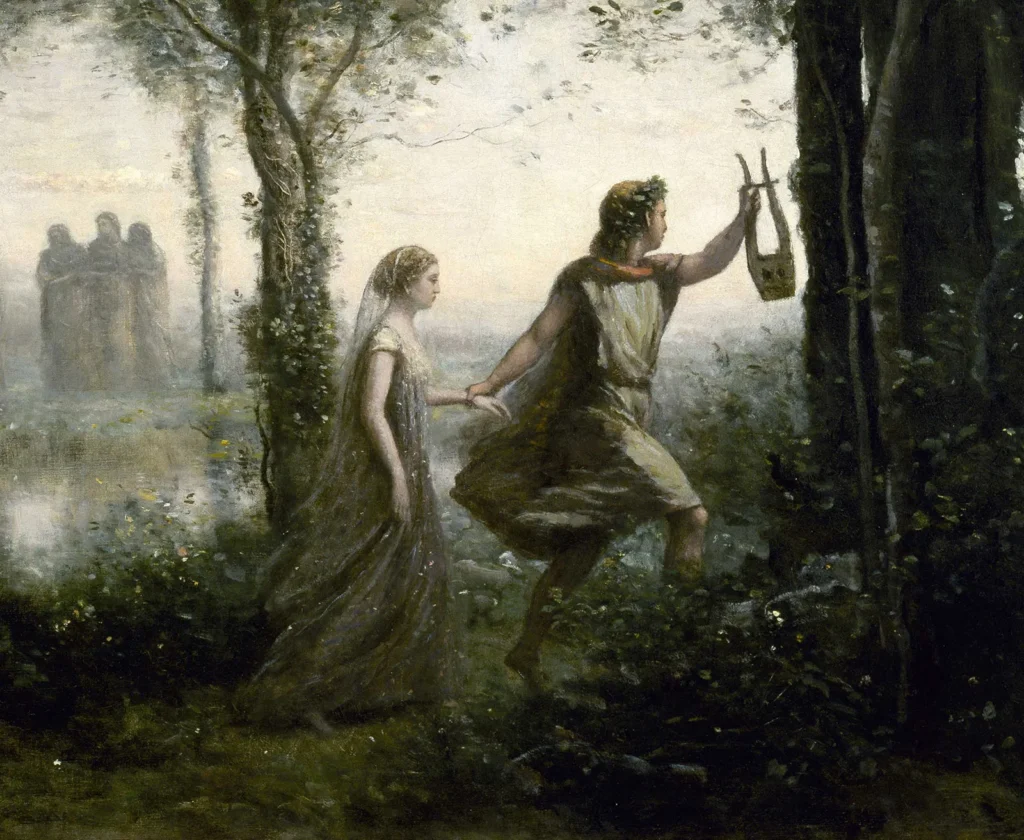
In the realm of Greek mythology, there exist few couples as iconic as Orpheus and Eurydice. While Orpheus is often regarded as the more famous of the two, their story is a poignant reminder that love can be both alluring and devastating. In this article, we will delve into the tale of Orpheus and Eurydice, exploring the mythological context, their musical talents, and the tragic events that led to their demise.
Orpheus: The Musical Genius
Orpheus, son of Aegus, a king of Thrace, and Calliope, the muse of epic poetry, was blessed with extraordinary musical abilities. According to legend, Apollo gifted him a lyre, which he then honed into a masterpiece under the guidance of the Muses themselves. His music had such profound effects that it could tame even the most ferocious beasts.
It is said that Orpheus’s musical talents were not limited to his playing of the lyre. He was also known for his remarkable singing voice, which could move mountains and calm the savage beast. The Muses themselves would often gather around him to hear him sing, and his performances were so captivating that they would forget their own roles and responsibilities.
The Story of Orpheus and Eurydice
Eurydice, daughter of Nereus and Doris, was a maiden so beautiful that she captured the hearts of many suitors, including Aristeus, who attempted to win her hand. However, Eurydice chose to flee from him, unaware of the danger that lay ahead. As she hurried along the path without looking down, she accidentally stepped on a venomous snake and died.
Orpheus was consumed by grief, and his music became his only solace. He descended into the underworld, accompanied by Charon and other spirits, to reclaim Eurydice from Hades himself. The rulers of the dead were moved by Orpheus’s sorrowful melodies, and they allowed him to take Eurydice back with him, but on one condition: he must not look at her until they reached the surface.
The Fateful Journey
As they journeyed towards the light, Orpheus began to fear that he might have been deceived. His doubts were so intense that he could no longer resist the urge to glance back at Eurydice. When he did, she was lost forever to him, doomed to remain in the underworld.
The reason behind Orpheus’s hesitation is a subject of much debate among scholars and mythologists. Some believe that it was his fear of being deceived by Hades, while others argue that it was simply his own human nature. Whatever the reason, the consequences were dire, and Eurydice was lost to him forever.
The Aftermath
Orpheus’s despair was absolute, and he retreated to Mount Helicon, where he spent the remainder of his days teaching young men about abstinence and the origins of the world. The gods themselves mourned the loss of their beloved musician, and a terrible pestilence swept through Thrace as punishment for Orpheus’s transgression.
The head of Orpheus was eventually recovered from a fisherman in the river Meletus and deposited at the foot of Mount Olympus. His lyre was placed among the stars, forming the constellation of Lyra, where it remains to this day.
Conclusion
The tale of Orpheus and Eurydice is an enduring testament to the power of love and music. Their story has captivated artists, writers, and musicians for centuries, inspiring countless adaptations and reinterpretations. As we reflect on their tragic fate, we are reminded that even the most beautiful melodies can be shattered by our own doubts and fears.
Frequently Asked Questions
- What was Orpheus’s relationship with Eurydice like?
Orpheus and Eurydice were deeply in love, and their bond was strengthened by his musical talents. - Why did Orpheus descend into the underworld?
He sought to reclaim Eurydice from Hades, driven by his overwhelming grief and determination. - What was the condition for Orpheus to take Eurydice back with him?
He had to not look at her until they reached the surface of the earth. - Why did Orpheus lose Eurydice again?
His doubts about being deceived led him to glance back at her, causing her to be lost forever in the underworld. - How was Orpheus’s death avenged?
The gods sent a pestilence upon Thrace as punishment for his transgression, and his head was eventually recovered. - What happened to Orpheus after his descent into the underworld?
He spent the remainder of his days teaching young men about abstinence and the origins of the world on Mount Helicon. - Is there any significance to the mythological constellation Lyra?
Yes, it is named after the lyre played by Orpheus, which was placed among the stars as a tribute to his musical talents. - How has the legend of Orpheus and Eurydice influenced art and literature?
The story has inspired countless adaptations, from opera to poetry, and continues to captivate audiences with its timeless themes of love and loss.
Orpheus’s Legacy
Despite his tragic fate, Orpheus’s legacy lives on through his music. His lyre is still played today by musicians around the world, and his melodies continue to inspire new generations of artists. The myth of Orpheus and Eurydice serves as a reminder that even in the darkest of times, there is always hope for redemption and forgiveness.
Eurydice’s Legacy
While Eurydice may not have lived forever, her legacy lives on through her love for Orpheus. Her story has captivated audiences for centuries, inspiring countless works of art and literature. She remains a symbol of love and devotion, reminding us that even in the face of adversity, our loved ones will always be with us in spirit.
Conclusion
The tale of Orpheus and Eurydice is a timeless reminder of the power of love and music. Their story has captivated audiences for centuries, inspiring countless adaptations and reinterpretations. As we reflect on their tragic fate, we are reminded that even the most beautiful melodies can be shattered by our own doubts and fears.
Final Thoughts
The myth of Orpheus and Eurydice serves as a reminder that love is a powerful force that can move mountains and calm the savage beast. However, it also reminds us that love can be fleeting and ephemeral, leaving behind only memories and melodies to remind us of its presence.
As we conclude our exploration of the timeless love of Orpheus and Eurydice, we are left with a sense of awe and reverence for these two figures from Greek mythology. Their story continues to captivate audiences around the world, inspiring new generations of artists, writers, and musicians.
References
- Apollodorus, The Library
- Hesiod, Theogony
- Ovid, Metamorphoses
- Euripides, Orpheus
Additional Resources
For those interested in learning more about the myth of Orpheus and Eurydice, we recommend the following resources:
- “The Musician’s Son” by Robert Graves
- “Orpheus: The Musical Genius” by Stephen Fry
- “The Greek Myths” by Robert Graves
We hope you enjoyed this article on the timeless love of Orpheus and Eurydice. If you have any further questions or would like to explore more of our content, please feel free to ask!


