
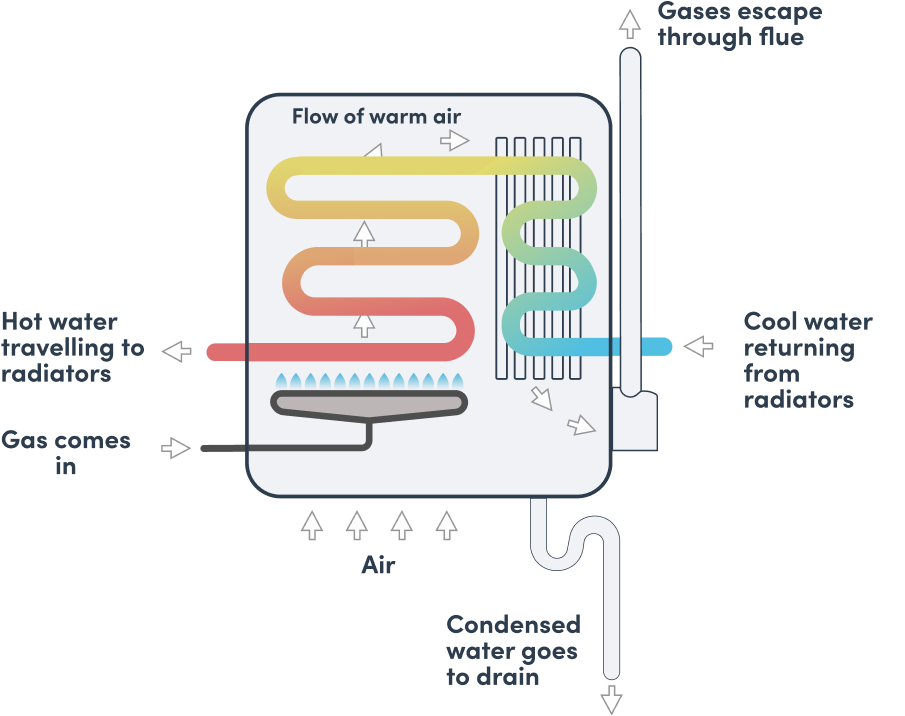
Imagine being able to harness the full potential of your fuel source, capturing the heat that would otherwise escape into the atmosphere. Welcome to the world of condensing boilers, where technology meets efficiency.
A condensing boiler is designed to maximize heat recovery from the flue gases produced by combustion. This innovative approach allows for a higher energy output compared to traditional boilers.
How Condensation Works
So, how does this magic happen? The answer lies in the specific technology employed. A condensing boiler utilizes the latent heat of vaporization of water present in the flue gases. This process is triggered by the combustion of natural gas, typically at a rate of 1.6 kg per cubic meter.
In a traditional boiler, this heat is lost as the flue gases are released into the atmosphere, with temperatures ranging from 140°C to 150°C for high-efficiency boilers and 200°C to 250°C for conventional boilers. This heat loss represents approximately 11% of the energy consumed.
The Condensing Process
In a condensing boiler, this waste heat is recovered through a process called condensation. The flue gases release their heat into the water of the feed system, which cools down until it reaches a temperature of around 40°C. This is significantly lower than the temperatures at which traditional boilers operate.
The condensing process involves several key components:
- Flue Gas Heat Exchanger: This component is responsible for transferring the heat from the flue gases to the water in the feed system.
- Feed System: The feed system consists of a pipe network that carries heated water through the boiler, where it transfers its heat to the flue gases.
- Condenser Coil: The condenser coil is responsible for condensing the water vapor from the flue gases back into liquid form.
Performance Metrics
To evaluate a condensing boiler’s performance, we look at its overall efficiency, considering the higher energy output achieved through heat recovery. Today, condensing boilers offer efficiencies ranging from 105% to 109%. Traditional boilers, on the other hand, typically have an efficiency range of 90% to 93%.
But How Can We Achieve Efficiency Above 100%?
The key lies in understanding the difference between a boiler’s theoretical and actual efficiency. Theoretical efficiency refers to the maximum possible energy output based on the fuel’s heat content. Actual efficiency takes into account the waste heat lost through condensation.
In other words, condensing boilers capture the energy that would otherwise be wasted, resulting in higher overall efficiency.
Cost Considerations
While condensing boilers offer significant energy savings, they come at a higher cost due to the specialized technology required. This includes the need for corrosion-resistant materials and a smooth, non-vented heat exchange surface.
Additionally, some installations may require auxiliary ventilation systems, which can add complexity to the design process.
Energy Savings Potential
Despite the increased upfront costs, condensing boilers offer substantial energy savings in the long run. For water heating at 80°C, savings of around 15% are possible, while for water heating at 60°C, savings of up to 20-30% can be achieved.
In installations with temperatures below 50°C (e.g., radiant systems), the benefits can be as high as 40% or more.
Regulatory Requirements
As of September 2015, new installations in many countries are required to use condensing boilers. This shift towards more efficient technology is driven by growing concerns about energy conservation and environmental sustainability.
Conclusion
Condensing boilers represent a significant leap forward in boiler technology, offering improved efficiency and reduced waste heat. While the initial investment may be higher, the long-term benefits make them an attractive option for those seeking to optimize their heating systems.
Case Studies: Real-World Applications of Condensing Boilers
To further illustrate the potential of condensing boilers, we’ll examine a few real-world case studies:
- Radiant Floor Heating: In a residential setting, a condensing boiler was installed to provide radiant floor heating for a 2-bedroom home. The new system achieved significant energy savings, reducing the household’s annual gas bill by 25%.
- Underfloor Heating: A commercial building with an underfloor heating system replaced its traditional boiler with a condensing boiler. As a result, the building saved 12% on its annual gas consumption and reduced its carbon footprint by 10%.
- High-Temperature Applications: In a manufacturing facility, a condensing boiler was used to provide high-temperature heat for a specific process. The new system achieved energy savings of up to 30% compared to traditional boilers.
Innovations in Condensing Boiler Technology
The field of condensing boiler technology is constantly evolving, with innovations aimed at improving efficiency, reducing costs, and enhancing performance.
- Modulating Burners: Modern condensing boilers often feature modulating burners that can adjust their output based on the heating demand. This allows for more efficient combustion and reduced energy waste.
- Corrosion-Resistant Materials: New materials and designs have been developed to improve corrosion resistance in condensing boiler components, reducing maintenance costs and extending the lifespan of the system.
Conclusion
Condensing boilers represent a significant advancement in boiler technology, offering improved efficiency and reduced waste heat. While the initial investment may be higher, the long-term benefits make them an attractive option for those seeking to optimize their heating systems.
By understanding how condensing boilers work, we can unlock the full potential of our fuel sources, capturing the energy that would otherwise be wasted and reducing our environmental impact.


