
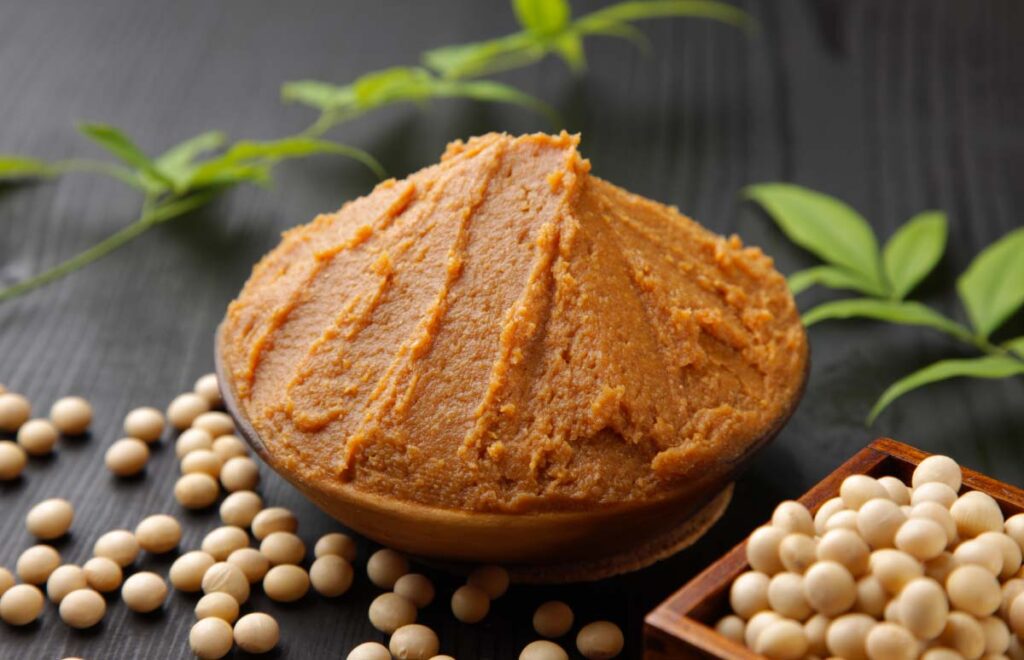
Miso, a condiment with a creamy consistency, is a staple of Japanese cuisine. Miso is the base ingredient for Japan’s famous miso soup, which has been enjoyed for centuries in Japan and has gained popularity worldwide due to its rich flavor and health benefits.
A Brief History of Miso
Traditionally, miso is made from fermented soybeans (or rice, or barley, or other grains). Despite being traditionally made from soybeans, it is possible to obtain miso by fermenting rice, barley, or other grains. The history of miso dates back to the 5th century in Japan, where it was first produced as a way to preserve soybeans and create a nutritious food source.
Ingredients Used in Miso Preparation
Soya (or rice or barley), salt and Koji fungus (fungus of the species Aspergillus oryzae). The koji fungus is a type of mold that helps to break down the proteins and carbohydrates in the soybeans, creating a fermented product with a rich flavor.
Nutritional Properties of Miso
Let’s start with calories: every 100 grams of soy miso contains 199 kcal. Here are the nutritional properties of Japanese soy miso:
- Carbohydrates: 26.47 g
- Fat: 6.01 g
- Proteins: 11.69 g
The proteins have an amino acid composition that includes triptophan, threonine, isoleucine, leucine, lysine, methionine, tyrosine, arginine, aspartic acid, proline…
Vitamins:
- Vitamin A 4 mcg
- Beta-carotene 52 mcg
- Vitamin B2 0.233 mg
- Vitamin B3 0.906 mg
- Vitamin B5 0.337 mg
- Vitamin B12 0.08 mg
- Vitamin K 29.3 mcg
- Choline 72.2 mg
Mineral salts:
- Calcium 57 mg
- Iron 2.49 mg
- Magnesium 48 mg
- Manganese 0.850 mg
- Phosphorus 159 mg
- Potassium 210 mg
- Sodium 3728 mg
- Zinc 2.59 mg
As we can see, the miso is rich in sodium, so if you are looking for contraindications, note that it cannot be consumed by those who follow an iodine-free diet or have high blood pressure problems.
Miso Savor and Types of Miso
It’s difficult to describe the taste of miso, but we’ll try. What does the miso taste like?
The flavor, aroma, texture, and appearance of miso can vary depending on the region of origin and the season of production. Other variables that affect the flavor of miso are the duration of fermentation and the temperature of fermentation, the amount of salt, the variety of koji, and the container used for fermentation.
To simplify things, we’ll say that the flavor of miso changes based on the type of miso. The most common categories are:
- White miso (Shiromiso)
- Red miso (Akamiso)
The most common types of miso are white and red (shiromiso and akamiso), however, in the eastern part of the Kato region (including Tokyo), dark/ red miso (akamiso) is more commonly used while in the western part of the Kansai region (Osaka, Kyoto and Kobe) white miso (shiro-miso) is more widely used.
Miso can be prepared starting from the fermentation of many ingredients, some examples being:
- Soya
- Barley
- Rice
- Wheat
- Millet
- Oats
- Canola seeds
Recently, producers in other countries (not Japan) are preparing miso with atypical ingredients such as chickpeas, corn, beans azuki, amaranth and quinoa.
Fermentation times vary depending on the type of miso, ranging from five days to several years. The wide variety of Japanese miso is difficult to classify but in general is classified based on the starting ingredients. Sometimes, miso is prepared with multiple starting ingredients. For example, Miso Gokoku is made from millet, rice, soybeans, wheat and wolfberry (Setaria italica also known as Italian millet).
Production Process of Miso
The production process of miso involves several steps:
- Fermentation: The first step in making miso is fermentation, which can take anywhere from five days to several years depending on the type of miso.
- Mixing: After fermentation, the miso paste is mixed with salt and other ingredients such as seaweed or koji fungus to enhance its flavor and texture.
- Aging: The miso paste is then aged for several months to allow the flavors to mature.
- Packaging: Finally, the miso is packaged and distributed to stores.
Where to Buy Miso
Miso can be found easily in specialty stores that sell Japanese food products or foreign goods. Those who prefer online shopping, the variety of miso is abundant and diverse, especially on Amazon where there are numerous types of miso, including organic and traditional ones.
On Amazon you will find:
- Miso of Soy, 300 grams: The traditional soy miso offered for 4.77 euros with free shipping.
- Rice Miso, 390 grams: The rice-based miso is produced using a biodegradable method and is offered at the price of 7.75 euros, with free shipping.
If you don’t want to get confused with Japanese recipes, you can buy instant miso soup. Instant miso soups are made with miso and other dehydrated ingredients. To serve the instant miso soup, all you need to do is boil a cup of water and add it to a pre-packaged container.
In this case, I would like to suggest a good product: Instant Miso Soup on Amazon. The package contains 4 servings of instant miso soup and is offered at a price of 5.24 euros with free shipping. It’s the classic miso soup made with seaweed wakame, rich in probiotic ingredients; the miso is fermented and therefore probiotic.
Tips for Using Miso
Miso can be used as an ingredient in various Japanese dishes such as miso soup, stir-fries, sauces, marinades, dips, salad dressings, and many others. Here are some tips for using miso:
- Start with a small amount: Miso is strong, so start with a small amount and adjust to taste.
- Mix with water or broth: To thin out the miso paste, mix it with water or broth before adding it to your dish.
- Use in combination with other ingredients: Combine miso with soy sauce, sake, mirin, and sugar for a sweet and savory marinade for meat or fish.
Conclusion
In conclusion, miso is a versatile condiment that can be used in various Japanese dishes. With its rich flavor and health benefits, it’s no wonder that miso has gained popularity worldwide. Whether you’re looking to add some excitement to your cooking or simply want to try something new, miso is definitely worth trying.
As we have seen, the production process of miso involves fermentation, mixing, aging, and packaging. The type of miso can vary depending on the starting ingredients, and there are many different types of miso available in the market.
If you’re interested in learning more about miso or would like to try some recipes that use miso as an ingredient, I highly recommend checking out some online resources or cooking books. Happy cooking!


