
Imagine a world where you can explore the vastness of space and discover new worlds beyond our own. This is the fascinating realm of our solar system, consisting of eight planets, dwarf planets, asteroids, comets, and other celestial bodies that have captivated human imagination for centuries.
The History of Exploring Our Solar System
For millennia, we believed that we were alone in the universe, with only Earth, the Sun, and the Moon as companions. However, thanks to space exploration, sonde, and scientists studying this field, we now know that our solar system is teeming with life. From the earliest astronomers to modern-day missions, we’ve come a long way in understanding the planets and their mysteries.
What Are Planets?
Planets are celestial bodies characterized by a cold outer surface, dimensions smaller than those of stars, and orbit around the Sun, making them visible in the night sky as they change positions relative to fixed stars. Yes, even Pluto and Mercury are planets that deviate from this rule but follow similar patterns.
The Nine Planets: A Tour
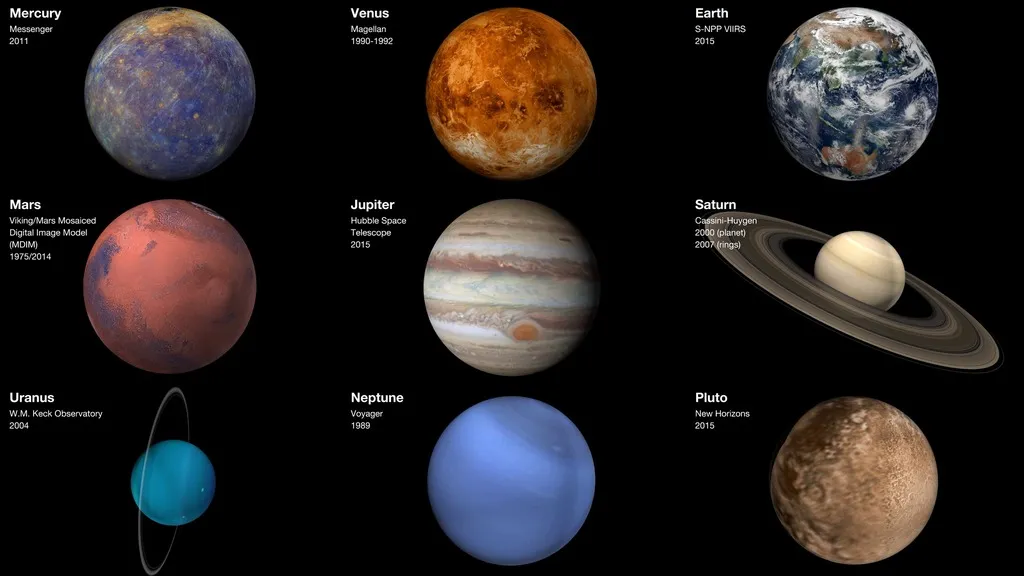
Let’s start our journey from the closest planet to the Sun and explore each of the nine planets in order. We have:
- Mercury: The smallest planet, with a surface temperature ranging from -170°C to 427°C (-274°F to 801°F).
- Venus: Often shrouded in thick clouds, its surface temperature can reach up to 462°C (863°F), making it the hottest planet.
- Earth: Our home planet, with a diverse range of environments and ecosystems that support life.
- Mars: Known for its reddish hue, Mars is a potential candidate for supporting life and has been studied extensively by NASA’s Curiosity Rover.
- Jupiter: The largest planet in our solar system, Jupiter is a gas giant with massive storms like the Great Red Spot.
- Saturn: Another gas giant, Saturn is known for its stunning ring system, composed of ice particles and rock debris.
- Uranus: An icy giant, Uranus has a tilted axis that leads to extreme seasons on the planet.
- Neptune: The farthest planet from the Sun, Neptune is also an icy giant with strong winds and massive storms.
The Five Dwarf Planets
In addition to the nine planets, there are five dwarf planets in our solar system:
- Pluto: Once considered the ninth planet, Pluto has a highly eccentric orbit and a surface composed of nitrogen ice.
- Eris: A dwarf planet in the Kuiper Belt, Eris is slightly larger than Pluto and has a highly inclined orbit.
- Ceres: The largest object in the asteroid belt, Ceres is a dwarf planet with a surface covered in craters and grooves.
- Haumea: An irregularly shaped dwarf planet, Haumea has a highly eccentric orbit and a reddish appearance.
- Makemake: A cold dwarf planet, Makemake has a highly inclined orbit and a surface composed of methane ice.
The Moons: Satellites of the Planets
In addition to the planets themselves, our solar system also includes numerous moons that orbit around them. Some of these moons are quite large, such as Ganymede, which orbits Jupiter, and Titan, which orbits Saturn.
Astronomy and Astrology
Planets have been used for centuries in astronomy and astrology to understand human behavior, personality traits, and destiny. In astrology, planets are grouped into categories: Luminari (Sun and Moon), Pianeti veloci (Mercury, Venus, and Mars), Pianeti semi-lenti (Jupiter and Saturn), and Lenti (Uranus, Neptune, and Pluto).
Fun Facts About Planets
For instance:
• The average distance between the Earth and the Sun is about 93 million miles (150 million kilometers).
• The largest planet in our solar system, Jupiter, has a diameter of approximately 142,984 kilometers (88,846 miles).
• The smallest planet, Mercury, has a diameter of approximately 4,879 kilometers (3,031 miles).
Resources for Exploring the Solar System
For those interested in learning more about the solar system, there are numerous resources available:
- “Stelle e Pianeti. La guida più completa a stelle, pianeti, galassie e al sistema solare”: A comprehensive guide that covers everything from stars and planets to galaxies and the solar system.
- Online books and articles: Websites like NASA, Space.com, and Astronomy Magazine offer in-depth information on the solar system and its many wonders.
The Search for Life Beyond Earth
While we’ve yet to find definitive evidence of life beyond our planet, ongoing research and missions aim to uncover signs of extraterrestrial life. The search for life is an essential aspect of space exploration, with scientists using a variety of methods to detect biosignatures in the atmospheres of exoplanets.
The Future of Space Exploration
As technology advances, we can expect to see more missions to explore our solar system and beyond. From landing on Mars to sending probes to distant galaxies, humanity’s presence in space will continue to grow. With private companies like SpaceX and Blue Origin leading the charge, the future of space exploration looks brighter than ever.
Conclusion
Our solar system is a vast and fascinating universe, full of mysteries waiting to be unraveled. From the smallest dwarf planet to the largest gas giant, each planet has unique features that make it worth exploring further. Whether you’re a seasoned astronomer or just starting to learn about the solar system, there’s always more to discover and explore.
Frequently Asked Questions
Here are some frequently asked questions related to our solar system:
- What is the farthest planet from the Sun?
- Neptune is the farthest planet from the Sun in our solar system.
- How many moons does Jupiter have?
- Jupiter has a whopping 79 known moons, with Ganymede being the largest one.
- Can humans live on Mars?
- While there’s no conclusive evidence that humans can live on Mars yet, ongoing research and missions aim to make it possible in the future.
- What is the largest planet in our solar system?
- Jupiter is the largest planet in our solar system, with a diameter of approximately 142,984 kilometers (88,846 miles).
- Can we visit Pluto?
- Currently, there are no manned missions to Pluto, but spacecraft like NASA’s New Horizons have sent back stunning images and data from this dwarf planet.
If you’re curious about more aspects of our solar system or want to explore further, feel free to ask us.


