
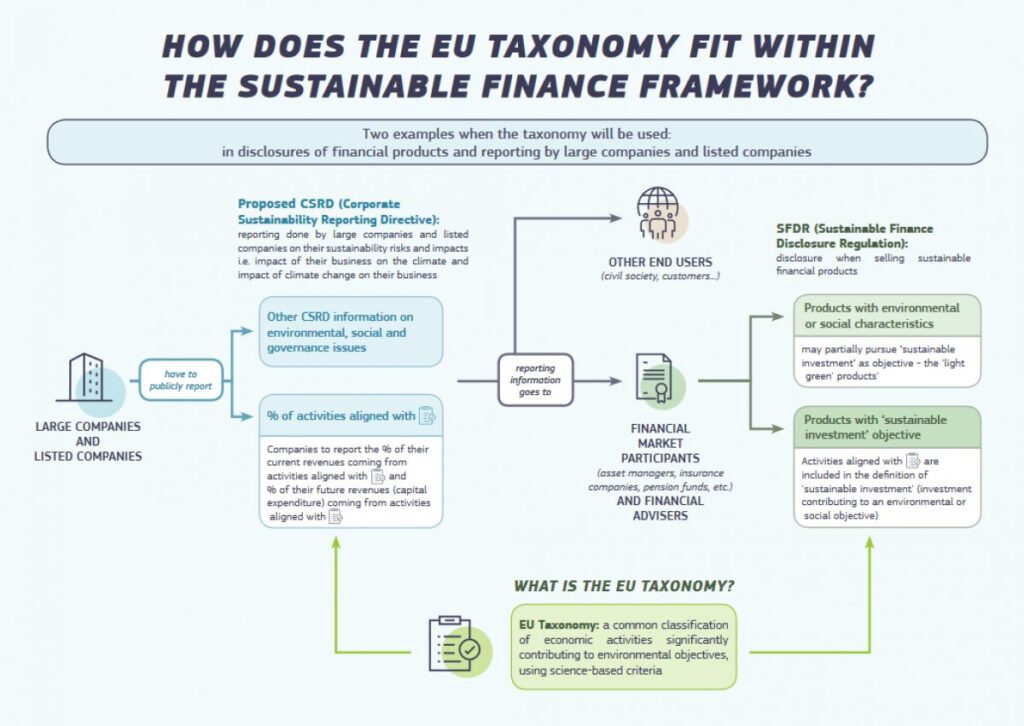
The European Green Taxonomy (EGT) is a system of classification for sustainable economic activities, established to bring clarity to financial markets regarding sustainability and identify green investments aligned with the European Green Deal. However, the EGT has been surrounded by controversy due to ongoing debates on including natural gas and nuclear energy within the taxonomy.
In this article, we will delve into the characteristics, strengths, and controversial aspects of the EGT, exploring the implications of its current definition and the future prospects of the taxonomy.
What is the European Green Taxonomy?
The EGT is a system of classification that aims to bring transparency and clarity to financial markets regarding sustainability. It covers six environmental objectives: mitigation and adaptation to climate change, sustainable use and protection of water and marine resources, transition to a circular economy, prevention and control of pollution, protection and restoration of biodiversity and ecosystems, and decarbonization.
The EGT is based on the principle of “not causing significant harm,” which means that an economic activity is considered green if it pursues one of the six environmental objectives and does not harm another. Additionally, activities must respect minimum social requirements, such as human rights and workers’ rights.
Technical Evaluation Criteria
The EGT has established technical screening criteria for businesses to identify sustainable economic activities. These criteria consist in metrics, thresholds of use and production (e.g., energy production with less than 100 g CO2e/kWh), or a gradual reduction in these thresholds.
However, the definition of the taxonomy is still evolving, and there are ongoing debates about including natural gas and nuclear energy within the framework.
Debate on Natural Gas and Nuclear Energy
The inclusion of natural gas and nuclear energy in the EGT has been a contentious issue. Some EU member states, such as France and Poland, have argued that these technologies can contribute to achieving climate neutrality and should be included in the taxonomy.
However, other countries, such as Austria and Germany, have expressed concerns about the potential risks associated with natural gas and nuclear energy, including greenhouse gas emissions and nuclear waste disposal.
The European Commission has ultimately decided to include natural gas and nuclear energy in the EGT, but with certain conditions. For example, only certain activities linked to these sources will be considered green, and there are specific criteria for determining when a gas-fired power plant can be converted to renewable energy.
Implications of Including Natural Gas and Nuclear Energy
The inclusion of natural gas and nuclear energy in the EGT has several implications:
- Risk of Greenwashing: The decision to include these technologies in the taxonomy could lead to greenwashing, where companies misrepresent their environmental credentials.
- Increased Use of Non-Sustainable Activities: The inclusion of natural gas and nuclear energy in the EGT could lead to an increase in their use beyond expected thresholds, as investors may assume that they are environmentally friendly.
- Loss of Credibility: The decision to include natural gas and nuclear energy in the EGT could undermine the credibility of the taxonomy and the European Green Deal.
Future Prospects
The future prospects for the EGT are uncertain. While the inclusion of natural gas and nuclear energy may have been a compromise, it has raised concerns about the potential risks associated with these technologies.
In order to restore the credibility of the taxonomy, the EU should:
- Revisit the Criteria: The criteria for determining when a gas-fired power plant can be converted to renewable energy need to be revised.
- Enhance Transparency: The taxonomy needs to be more transparent, allowing investors and stakeholders to understand the potential risks associated with natural gas and nuclear energy.
- Promote Renewable Energy: The EU should prioritize the development of renewable energy sources, which are essential for achieving climate neutrality.
In conclusion, the European Green Taxonomy is a complex system that aims to bring transparency and clarity to financial markets regarding sustainability. However, the inclusion of natural gas and nuclear energy in the taxonomy has raised concerns about greenwashing, increased use of non-sustainable activities, and loss of credibility. To restore the credibility of the taxonomy, the EU needs to revisit the criteria, enhance transparency, and promote renewable energy.
FAQs
- What is the European Green Taxonomy?
The EGT is a system for classifying sustainable economic activities in line with EU regulations.
- Why does the EGT exist?
The EGT exists to bring clarity and transparency to financial markets regarding sustainability, identify green investments aligned with the European Green Deal, and prevent greenwashing.
- What are the six environmental objectives of the EGT?
The EGT covers six environmental objectives: mitigation and adaptation to climate change, sustainable use and protection of water and marine resources, transition to a circular economy, prevention and control of pollution, protection and restoration of biodiversity and ecosystems, and decarbonization.
- What is the principle of “not causing significant harm” in the EGT?
The principle of “do not significantly harm” states that an economic activity is considered green if it pursues one of the six environmental objectives and does not harm another objective.
- How are businesses considered green under the EGT?
Businesses are considered green based on their ability to satisfy one of the six environmental objectives, which are connected through the principle of “do not significantly harm”.
- What implications does the inclusion of natural gas and nuclear energy have for the EGT?
The inclusion of natural gas and nuclear energy in the EGT has raised concerns about greenwashing, increased use of non-sustainable activities, and loss of credibility.
- How can the EU restore the credibility of the taxonomy?
The EU should revisit the criteria, enhance transparency, and promote renewable energy to restore the credibility of the taxonomy.
- What are the potential risks associated with natural gas and nuclear energy in the EGT?
The inclusion of natural gas and nuclear energy in the EGT has raised concerns about greenhouse gas emissions, nuclear waste disposal, and loss of public confidence.


