
The Astenosphere: Understanding the Inner Earth’s Fascia
As we venture deeper into the Earth’s interior, we find ourselves in a realm that affects us all – despite our physical presence on the surface. The astenosphere, one of the many internal layers of the Earth, plays a crucial role in shaping our planet’s dynamics.
What is the Astenosphere?
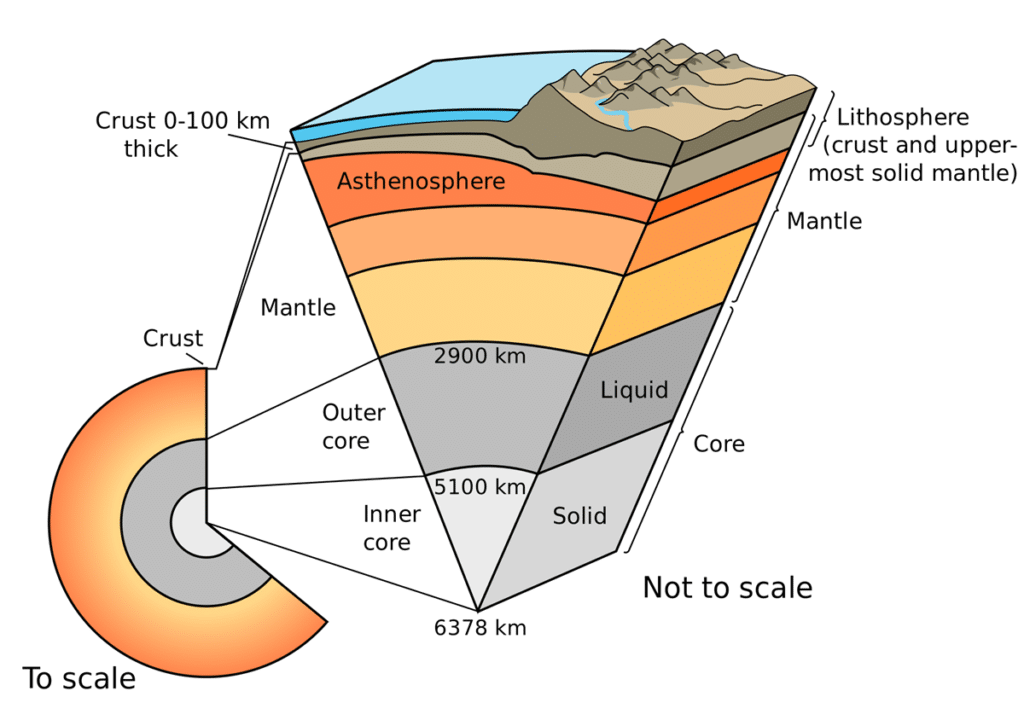
The astenosphere is a relatively superficial layer of the Earth’s mantle, situated just beneath the lithosphere but above the mesosphere. Its depth extends between 250 and 300 kilometers, with rocks that are partially melted and not entirely solid. This characteristic leads to significant consequences.
To understand the asthenosphere, it is essential to comprehend its position within the Earth’s structure. The Earth can be divided into several layers:
- Crust: The outermost layer of the planet, ranging in thickness from 5-70 kilometers.
- Lithosphere: A combination of crust and upper mantle, with a total thickness of approximately 150 kilometers.
- Asthenosphere: A partial melting zone beneath the lithosphere, spanning around 250-300 kilometers.
- Mesosphere: A deeper layer within the Earth’s mantle, located between 400-650 kilometers below the surface.
The astenosphere is situated above the mesosphere and below the lithosphere, making it a crucial component of our planet’s internal dynamics.
Motifs Convection in the Asthenosphere
The convection process in the astenosphere is closely tied to the fact that its rocks are not solid. Observations of varying seismic wave speeds in this layer have sparked interest in this region’s unique properties. The astenosphere is known as a low-velocity zone, or LVZ, due to the significant decrease in seismic wave speed.
In this region, we find a type of fluid with extremely high viscosity, where isostatic movements occur due to variations in crustal weight. Within the asthenosphere, convection takes place in cellular-like structures, transferring energy to the lithosphere and driving plate tectonics.
The convection process within the astenosphere is influenced by several factors:
- Temperature: The temperature within this layer exceeds 1,000 °C, leading to partial melting of rocks.
- Pressure: High pressure conditions below the surface contribute to the high viscosity of the material.
- Composition: The composition of the rocks in the asthenosphere plays a significant role in determining its properties.
These factors combine to create a unique environment within the asthenosphere, where convection processes play a crucial role in shaping our planet’s dynamics.
Astenospheric Plasticity
The term “astenospheric plasticity” refers not to the presence of plastic materials but rather to its physical properties. The material’s slow response to external forces is akin to a “plastic” state, as opposed to what is observed in other parts of the Earth’s mantle.
Astenospheric plasticity is characterized by:
- High viscosity: The material exhibits high viscosity due to its partial melting and complex composition.
- Low strength: The astenosphere has relatively low strength compared to other parts of the Earth’s mantle.
- Non-linear behavior: The material’s response to external forces is non-linear, leading to complex interactions with surrounding rocks.
These properties make the asthenosphere a unique component within our planet’s internal dynamics.
Temperature and Composition
Located between 70 and 250 kilometers beneath the surface, the astenosphere consists of rocks close to their melting point, leading to its characteristic plastic behavior. The temperature within this layer exceeds 1,000 °C, making it one of the hottest regions in the Earth’s interior.
The composition of the rocks in the asthenosphere is also significant. It typically consists of:
- Partially melted rocks: Rocks that are partially molten due to high temperatures and pressures.
- Silicate minerals: Common minerals found in the Earth’s mantle, such as olivine and pyroxene.
- Iron-rich minerals: Iron-rich minerals like garnet and peridotite play a crucial role in shaping the asthenosphere.
These components interact with each other to create a complex environment within the astenosphere, influencing its properties and behavior.
The Asthenosphere: A Global Phenomenon
When discussing the asthenosphere, we’re referring to the layer beneath our planet’s crust, particularly oceanic and continental ones. While it’s not possible to access this region directly, its existence has been confirmed through various means, including seismic activity and studies since 1926.
The asthenosphere plays a vital role in global tectonics, influencing plate movement and the Earth’s dynamics. Its behavior is closely tied to:
- Plate tectonics: The interaction between tectonic plates and the asthenosphere drives plate movement.
- Seismic activity: Earthquakes and seismic waves provide valuable information about the asthenosphere’s properties.
- Volcanic activity: Volcanoes are often located near the asthenosphere, where magma rises to the surface.
The asthenosphere’s influence on global tectonics is significant, as it:
- Drives plate movement: The asthenosphere’s plastic behavior allows for the transfer of energy from the Earth’s interior to the lithosphere.
- Influences climate change: Changes in the asthenosphere’s temperature and composition can impact the Earth’s climate.
Origin of the Name
So, where does the term “asthenosphere” come from? Derived from the Greek word “asthenēs,” meaning ‘weak’ or ‘decreased strength,’ paired with “sfera,” this name reflects its unique properties as a relatively weak and fluid-like layer within our planet.
The term was first coined by French geologist Édouard Suess in 1885, who recognized the asthenosphere’s distinct characteristics. Since then, the term has become widely accepted in the scientific community, representing a crucial component of our understanding of the Earth’s internal dynamics.
Conclusion
In conclusion, the astenosphere is a unique and fascinating region within the Earth’s interior. Its properties, including high viscosity, low strength, and non-linear behavior, make it an essential component in shaping our planet’s dynamics.
The asthenosphere’s influence on global tectonics, seismic activity, and volcanic eruptions cannot be overstated. Understanding its behavior is crucial for improving our comprehension of the Earth’s internal processes and their impact on climate change.
As we continue to explore the Earth’s interior, it is essential to recognize the importance of the astenosphere in our planet’s dynamics. Its unique properties make it a fascinating topic of study, offering insights into the complex interactions within the Earth’s internal environment.
Recommended Reading
- Mesosphere: Earth’s Atmosphere and Composition
- Lithosphere: Significance and Structure
By Marta Abbà, March 17th, 2018


