
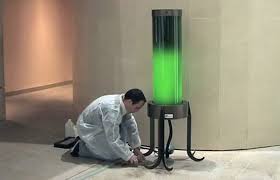
Are you tired of living in areas with poor air quality? Do you dream of having fresh, clean air wherever you go? Well, we have some exciting news for you. Imagine a lamp that can absorb as much CO2 as 200 trees, and do it all without harming the environment.
But what if this lamp could be even more powerful? What if it could revolutionize urban areas by providing clean air in places where pollution is a major problem? Sounds like science fiction, right? Well, believe it or not, it’s based on biochemistry!
In recent years, we’ve seen innovative solutions to energy production and consumption. We’ve had lamps powered by solar energy, lamps made from recycled materials, and even wind-powered lamps. But this latest innovation takes the cake – or rather, the CO2.
Meet Pierre Callejache: The Inventor Behind This Game-Changing Lamp
Pierre Callejache, a French biochemist, has created an incredible device that can absorb CO2 at an astonishing rate. His lamp uses specific microalgae to trap carbon dioxide from the air and produce oxygen as a byproduct of photosynthesis.
But how does it work? Simply place the lamp in direct sunlight, add water, and blow into the opening to introduce CO2-rich air. The lamp will then illuminate as the algae absorb the CO2.
The Science Behind This Revolutionary Lamp
This innovative technology has sparked both excitement and curiosity among environmentalists and scientists alike. The process is based on the natural phenomenon of photosynthesis, where plants convert sunlight into energy. In this case, the microalgae are used to mimic the same effect, harnessing energy from sunlight to absorb CO2.
The science behind this lamp can be broken down into several key components:
- Microalgae: These tiny organisms have the ability to absorb CO2 and produce oxygen through photosynthesis. They’re naturally occurring in ponds and lakes, but Callejache’s microalgae are specifically engineered for optimal carbon sequestration.
- Photosynthesis: This process occurs when plants, algae, and some bacteria convert sunlight into energy. In the case of this lamp, the microalgae use sunlight to absorb CO2 and produce oxygen.
- Carbon Sequestration: This refers to the removal of CO2 from the atmosphere. The lamp’s microalgae are engineered to capture as much CO2 as possible, producing oxygen in the process.
The Impact: A Cleaner Future for Urban Areas
Imagine breathing fresh air in urban areas, where pollution often dominates. This lamp has the potential to revolutionize cityscapes by providing clean air in even the most polluted environments. By reducing our reliance on fossil fuels and harnessing renewable energy, we can create a more sustainable future.
Some of the key benefits of this technology include:
- Improved Air Quality: The lamp provides fresh air in areas where pollution is a major problem.
- Renewable Energy: The lamp uses sunlight to power its CO2 absorption capabilities.
- Carbon Sequestration: The microalgae capture as much CO2 as possible, producing oxygen in the process.
The Current State of Development: Speriments and Partnerships
While this innovative technology is still in its experimental stages, some prototypes have already been tested in France, particularly in Libourne. However, further funding and partnerships are needed to bring this game-changing innovation to mass production.
Some of the key challenges facing this technology include:
- Scalability: The lamp’s microalgae must be engineered to capture as much CO2 as possible, while also producing oxygen.
- Cost-Effectiveness: The cost of producing and distributing these lamps will need to be brought down in order for them to become commercially viable.
Despite these challenges, the potential impact of this technology is vast. If successful, it could revolutionize urban areas by providing clean air in even the most polluted environments.
Conclusion: A Brighter Future for All
As we look towards a more sustainable future, it’s essential to consider innovative solutions like this green lamp. By harnessing the power of microalgae and renewable energy, we can create a cleaner, healthier world for all.
In conclusion, this revolutionary innovation has the potential to transform urban areas by providing clean air in even the most polluted environments. With further development and partnerships, it’s possible that this technology could become commercially viable in the near future.
FAQs: Answering Your Burning Questions
- How does the lamp work?
The lamp uses specific microalgae to absorb CO2 from the air, producing oxygen as a byproduct of photosynthesis. - What makes this technology so innovative?
This lamp is powered by renewable energy and harnesses the power of photosynthesis to absorb CO2 at an astonishing rate. - Can I install this lamp in my home?
While it’s still experimental, further testing and development are underway to make it more accessible for homes. - What kind of energy does the lamp require?
The lamp requires sunlight to function, making it a low-maintenance solution. - How much CO2 can the lamp absorb per year?
The lamp is estimated to absorb at least 150-200 trees’ worth of CO2 annually. - Can this technology be scaled up for industrial use?
Yes, with further development and partnerships, this technology has the potential to revolutionize industries worldwide. - What kind of environmental impact does this have on local ecosystems?
This lamp is designed to provide clean air in polluted areas, reducing the negative impacts of urban pollution on local ecosystems. - How long will it take for this technology to become commercially available?
Further testing and development are underway; expect updates soon.
Additional Resources
For more information on this groundbreaking innovation, please visit [link].


