
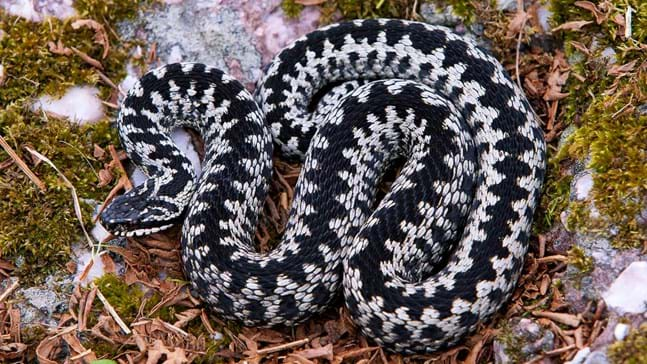
As we venture into the Italian wilderness, it’s natural to feel apprehensive when encountering snakes. However, with this guide, you’ll learn how to distinguish the five species of venomous snakes that inhabit Italy from non-venomous snakes.
The Shape of Their Eyes: A Key Differentiator
One of the most noticeable differences between vipers and snakes lies in their eyes. Snakes, including all non-venomous species (colubrids), have a peculiarly rounded pupil. In contrast, vipers have a higher, more elliptical-shaped pupil.
This characteristic is particularly evident when observing the snake’s gaze or behavior. Vipers tend to maintain a fixed stare, while snakes often display a more relaxed expression.
The Body: A Distinctive Feature
Another key difference is the length of their tails. Vipers have a shorter, thicker tail, while snakes have a longer, thinner one. This variation can be observed when examining the snake’s body from various angles or during a close encounter.
Distinguishing by Dentition
Inspecting their teeth can also help identify venomous snakes. Vipers have two prominent front teeth (incisors) that are capable of inflicting deep wounds. The incisors of non-venomous snakes, on the other hand, are typically smaller and less noticeable.
This characteristic is particularly evident when examining the snake’s mouth or jaw structure. Venomous vipers tend to have more pronounced and curved incisors than their non-venomous counterparts.
Recognizing the Five Species of Venomous Snakes in Italy
Here’s a brief overview of the five species of venomous snakes found in Italy:
- Vipera aspis: Also known as the common viper, this is the most widespread species.
- Habitat: Found throughout much of Italy, including urban areas and rural landscapes.
- Distribution: Widespread across central, southern, and northern regions.
- Vipera berus: Found only in the Alpine and Apennine regions.
- Habitat: Typically inhabits mountainous and hilly terrain.
- Distribution: Limited to the Alpine and Apennine regions of Italy.
- Vipera ammodytes: Considered the most venomous, this species is found in the Alpine and pre-alpine regions. It’s also known as the viper with a horn.
- Habitat: Prone to inhabiting rocky outcrops, scrublands, and alpine meadows.
- Distribution: Found in the Alpine and pre-alpine regions of Italy.
- Vipera ursini: Limited to the Abruzzo, Umbria, and Marche mountain ranges.
- Habitat: Typically inhabits mountainous and hilly terrain.
- Distribution: Found only in the mountain ranges of central Italy.
- Vipera walseri: Found in the Western Alps and specifically in the province of Biella.
- Habitat: Prone to inhabiting rocky outcrops, scrublands, and alpine meadows.
- Distribution: Limited to the Western Alps and the province of Biella.
Other Venomous Snakes to Be Aware Of
While not typically deadly, other venomous snakes found in Italy include:
- Malpolon monspessulanus: A limited species found in Liguria and Lampedusa.
- Habitat: Typically inhabits coastal areas and rocky outcrops.
- Distribution: Found only in the provinces of Imperia and Savona, as well as on the island of Lampedusa.
- Telescopus fallax: Also known as the cat snake, this species is commonly found in the northeast of Italy.
- Habitat: Prone to inhabiting rocky outcrops, scrublands, and agricultural areas.
- Distribution: Found throughout much of northern Italy, including urban areas and rural landscapes.
The Color of a Snake: Not a Reliable Indicator
While the color of a snake can be an important distinguishing feature for some species, it’s not always reliable. The coloration of vipers can vary significantly between different species and even within the same individual.
For instance, the female common viper may appear differently colored than its male counterpart, while young vipers often have distinct markings that fade as they mature.
Recognizing the “Viper-like” Biscia maura
The biscia maura (Natrix maura), also known as the viper snake or water snake, is often mistaken for a venomous snake. This species has a more robust build and a rounded head with a distinctively shaped pupil. However, it’s essential to examine the snake’s body and tail carefully before making an identification.
Additional Tips for Snake Identification
- Observe the snake’s behavior: Venomous snakes tend to be more aggressive and defensive when threatened or cornered.
- Examine the snake’s scales: Vipers have distinctive patterns of dark and light coloration on their bodies, while non-venomous snakes often display more uniform coloration.
- Check for a rattle or hissing sound: Some venomous snakes, like the viper with a horn, are known to produce a distinctive rattling or hissing sound when threatened.
Precautions When Encountering Venomous Snakes
While encountering a venomous snake can be alarming, it’s essential to remain calm and follow proper precautions:
- Maintain a safe distance: Keep a safe distance from the snake to avoid being bitten.
- Avoid direct contact: Never touch or handle a venomous snake, even if you’re certain it’s not deadly.
- Seek medical attention: If you’re bitten by a venomous snake, seek medical attention immediately.
By understanding the differences between vipers and snakes, as well as recognizing the unique characteristics of each species, you can better appreciate these fascinating creatures and stay safe in their presence.


