
The Future of Irrigation: How WaterBee is Revolutionizing Agriculture
As the world grapples with the challenges of climate change, water scarcity, and food security, innovative solutions are emerging to address these pressing issues. One such solution is WaterBee, a cutting-edge irrigation system that’s set to revolutionize agriculture. In this article, we’ll delve into the world of WaterBee, exploring its benefits, features, and potential impact on the agricultural industry.
What is WaterBee?
WaterBee is an automated irrigation system designed to optimize water usage in agriculture. This innovative technology uses sensors and AI to detect soil moisture levels, calculate water requirements, and adjust irrigation schedules accordingly. By minimizing waste and ensuring precise water application, WaterBee aims to conserve water while improving crop yields.
A System of Efficiency
WaterBee is more than just a system; it’s already in use in 14 European farms, yielding impressive results. These pioneering farmers are enjoying a 40% reduction in water consumption, along with enhanced crop quality and productivity. The effectiveness of WaterBee has been proven through extensive trials, demonstrating its potential to transform agricultural practices.
The Irrduino Connection
As we previously explored, Irrduino is another groundbreaking irrigation system developed by Google’s engineering team. While both systems share similarities, WaterBee offers a more comprehensive solution. By integrating sensors and AI, WaterBee can detect soil moisture levels and adjust irrigation schedules in real-time. This intelligent approach ensures that crops receive exactly the right amount of water, reducing waste and optimizing yields.
WaterBee: The Smart Irrigation System
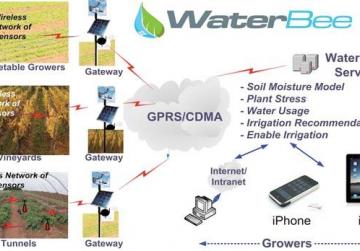
So, how does WaterBee work its magic? At its core, the system consists of sensors that monitor soil moisture levels and environmental factors influencing evaporation. These data points are then transmitted to a central controller using ZigBee technology, which enables efficient communication between nodes. A gateway GPRS sends collected data to a web-based service, where software analysis identifies areas requiring selective irrigation.
The Benefits of WaterBee
By utilizing this smart irrigation system, farmers can reap numerous benefits:
- Reduced water consumption: By optimizing water application, farmers can minimize waste and conserve precious resources.
- Improved crop quality and productivity: Precise water application ensures that crops receive exactly the right amount of moisture, leading to enhanced growth and yields.
- Increased efficiency through real-time monitoring: With WaterBee’s advanced sensors and AI capabilities, farmers can make data-driven decisions to optimize their irrigation schedules.
- Enhanced decision-making capabilities: The system’s web-based interface provides farmers with valuable insights into soil moisture levels, environmental factors, and irrigation performance.
Water Conservation: A Global Imperative
The importance of water conservation cannot be overstated. As our planet’s water resources dwindle, innovative solutions like WaterBee are essential in addressing this pressing issue. By minimizing waste and optimizing water application, we can ensure a more sustainable future for agriculture and beyond.
Sustainability and Environmental Impact
WaterBee is not only an effective solution for reducing water consumption but also has a positive impact on the environment. By conserving water, farmers can reduce their carbon footprint, minimize energy consumption, and preserve natural resources.
Conclusion
In conclusion, WaterBee is an innovative irrigation system that’s poised to transform agricultural practices worldwide. Its cutting-edge technology, real-time monitoring capabilities, and ability to minimize waste make it an essential tool for forward-thinking farmers. As the world grapples with water scarcity and food security challenges, solutions like WaterBee are vital in addressing these pressing issues.
Frequently Asked Questions
- What is the main benefit of using WaterBee?
- The primary advantage of WaterBee lies in its ability to minimize water waste while optimizing crop yields.
- How does WaterBee work its magic?
- WaterBee uses sensors to monitor soil moisture levels and environmental factors, transmitting data to a central controller for real-time analysis.
- Can WaterBee be used in urban areas?
- While primarily designed for agricultural applications, WaterBee’s smart irrigation system can be adapted for use in urban areas with minimal modification.
- What is the potential impact of WaterBee on food security?
- By optimizing water application and minimizing waste, WaterBee has the potential to significantly enhance global food security by ensuring a stable supply of nutritious crops.
- Is WaterBee energy-efficient?
- Yes, WaterBee’s use of ZigBee technology and low-power controller ensures efficient communication between nodes while minimizing energy consumption.
- Can I use WaterBee for personal gardening or landscaping projects?
- While WaterBee is primarily designed for large-scale agricultural applications, its smart irrigation system can be adapted for smaller projects with some modifications.
- What kind of maintenance is required for WaterBee?
- Regular software updates and sensor cleaning are necessary to ensure optimal performance.


