
Introduction
Deep in the heart of Portugal lies a horse breed that has been shrouded in mystery for centuries. The Sorraia horse is one of the oldest breeds in Europe, with roots dating back to prehistoric times. With its unique characteristics and striking appearance, it’s little wonder why this ancient breed continues to fascinate equine enthusiasts around the world.
The Origins of the Sorraia Horse
In 1920, a Portuguese zoologist named Ruy d’Andrade stumbled upon a small group of Sorraia horses in Coruche, Portugal. Intrigued by their unique appearance, he began studying and breeding them. However, it wasn’t until 2004 that Hardy Oelke, a German horse enthusiast, established a natural reserve to protect this rare breed.
The discovery of the Sorraia horse is attributed to Ruy d’Andrade’s tireless efforts to understand the genetics and behavior of these horses. Through his research, he recognized the unique characteristics that set them apart from other breeds and determined that they were an ancient breed with a rich history.
Characteristics: Height, Weight, and Physical Appearance
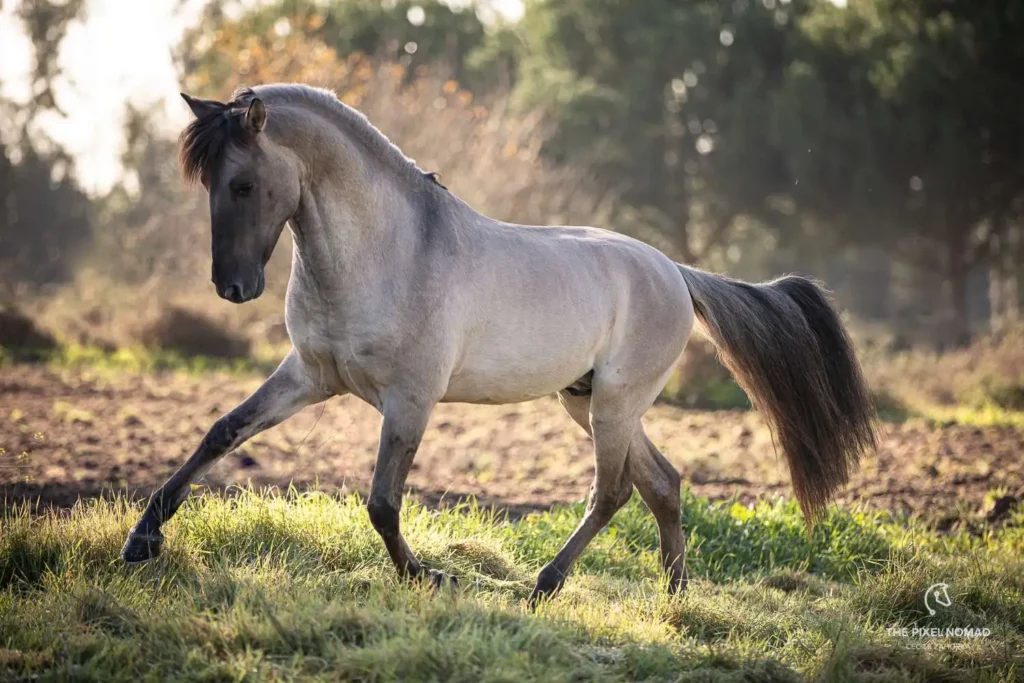
One of the most striking features of the Sorraia horse is its unique physical appearance. Adult Sorraias can reach heights of 140-150 cm at the withers and weigh between 250-300 kg. With a robust and muscular build, this breed is characterized by a wide but attached head, a long and slender neck, and a convex profile. Their body shape is harmonious, with prominent shoulders, an angled back, and strong legs ending in well-proportioned hooves.
Their coat is thick and coarse, often grayish-brown or bay in color, but featuring distinctive characteristics such as the riga mulina dorsal line, zebration on their limbs, and a dark muzzle. Additionally, their criniera can be black with white hairs, and sometimes features white markings, although these are rare and non-standard.
The Sorraia’s Potential Progenitor: The Tarpan
While some researchers believe the Sorraia horse may have originated from the ancient Tarpan breed, there is also evidence to suggest that it may be a descendant of the Andalusian and Lusitano breeds. With its unique physical characteristics and adaptability to harsh environments, it’s possible that the Sorraia has evolved into a distinct variant of the Tarpan.
The Tarpan, an extinct horse breed native to Eastern Europe, is believed to have been one of the first domesticated horses. Its extinction in the 19th century led to speculation about its potential influence on other breeds. Researchers believe that the Sorraia may have inherited characteristics from the Tarpan, such as its robust build and adaptability to harsh environments.
The Sorraia Horse: A Free-Spirited Breed
Due to their history of living free in the wild, Sorraias have developed an independent and resilient nature. While they can be gentle companions, they are not easily trained and require patient handling. Their natural ability to thrive on poor-quality pasture makes them well-suited for rugged terrain.
In the wild, Sorraias roamed freely, often living alone or in small herds. This independence has led to a breed that is wary of humans and requires careful handling. However, those who have had the pleasure of working with Sorraias report their intelligence, curiosity, and affectionate nature.
Allevaments and Conservation Efforts
Unfortunately, there are currently few Sorraia horses in Italy, with most individuals imported from North America due to the breed’s rarity. However, thanks to Hardy Oelke’s tireless efforts, these magnificent creatures can now be found in their natural habitat.
Today, we estimate that there are only around 200 Sorraias remaining, with some scattered across Portugal and a small number in Germany. As conservation efforts continue, it is essential that we learn more about this incredible breed and work to preserve its unique genetic makeup for future generations.
Conservation efforts include establishing breeding programs, protecting their natural habitat, and educating the public about the importance of preserving this rare breed. By working together, we can ensure the long-term survival of the Sorraia horse and allow it to continue to thrive in its native Portugal.
Genetic Preservation and Breeding Programs
To preserve the genetic makeup of the Sorraia breed, breeding programs have been established to select and breed individuals with desirable traits. These programs aim to maintain a stable gene pool while introducing new bloodlines to prevent inbreeding.
Selective breeding is crucial for preserving the unique characteristics of the Sorraia horse. By choosing horses with desirable traits, such as strong conformation, good temperament, and suitable coloration, breeders can create offspring that retain these valuable qualities.
Conclusion
The Sorraia horse is an extraordinary example of nature’s ingenuity, adapted to thrive in the harshest environments. With its striking appearance, unique characteristics, and free-spirited personality, it is little wonder why this ancient breed continues to captivate equine enthusiasts worldwide. As we strive to protect and preserve this rare breed, we are reminded of the importance of preserving our planet’s natural heritage for generations to come.
Frequently Asked Questions
- What is the origin of the Sorraia horse?
The Sorraia horse originated in Portugal, with its history dating back to prehistoric times. - How tall and heavy are Sorraia horses?
Adult Sorraias can reach heights of 140-150 cm at the withers and weigh between 250-300 kg. - What is unique about a Sorraia horse’s physical appearance?
Their thick, coarse coat, distinctive riga mulina dorsal line, zebration on their limbs, and dark muzzle set them apart from other breeds. - Is the Sorraia horse related to the Tarpan breed?
While some researchers believe they may be a descendant, there is also evidence to suggest that it may have originated from the Andalusian or Lusitano breeds. - Can Sorraias be trained and handled easily?
No, due to their independent nature, Sorraias require patient handling and are not easily trainable. - Where can I find Sorraia horses?
Currently, most Sorraias are found in Portugal, with a small number in Germany, and some individuals have been imported from North America. - How many Sorraia horses are there?
We estimate around 200 Sorraias remain, although exact numbers may vary due to ongoing conservation efforts. - What can I do to help protect the Sorraia breed?
Support conservation efforts, learn more about this incredible breed, and advocate for its preservation.
Additional Resources
For those interested in learning more about the Sorraia horse, there are several resources available:
- The International Society for Equine Science (ISES) offers detailed information on the Sorraia breed, including its history, characteristics, and conservation status.
- The United Nations Food and Agriculture Organization (FAO) provides guidance on equine breeding programs and genetic preservation strategies.
- The American Paint Horse Association (APHA) has a comprehensive database of horse breeds, including the Sorraia.
By exploring these resources and supporting conservation efforts, we can help ensure the long-term survival of this incredible breed.


