
As we explore the world around us, it’s easy to overlook the intricate details that make up our planet. But beneath our feet lies a vast and fascinating world of rocks, each with its unique characteristics and stories to tell. That’s where petrography comes in – the science of studying rocks, minerals, and their textures.
What is Petrography?
Petrography is the study of rocks, focusing on their mineral composition, texture, and structure. It’s a branch of geology that seeks to understand the formation and evolution of rocks through careful observation and analysis. By examining rocks in situ, petrographers can gain insights into the Earth’s history, climate, and geological processes.
Petrography: The Study of Igneous Rocks
Petrography has several branches, but one of the most specific is the study of igneous rocks. Igneous rocks are formed from the cooling and solidification of magma or lava. There are three main types of igneous rocks: intrusive (plutonic), extrusive (volcanic), and hybrid.
Characteristics of Igneous Rocks
Igneous rocks have unique textures that can be classified into several categories:
- Aphanitic: A fine-grained texture formed by rapid cooling or dehydration of magma.
- Amigdaloide: Characterized by vesicles filled with secondary minerals, producing a coarse-grained texture.
- Faneritica (or Granulare): Shows visible crystals, such as those found in granite.
- Ofitic: Exhibits a fine-grained texture, often composed of a felt-like arrangement of crystals or glassy fragments.
Petrography and Mineralogy
Petrography is closely related to mineralogy, the study of minerals. While petrographers focus on rocks, mineralogists examine the chemical composition, crystal structure, and physical properties of individual minerals. The two fields complement each other, as understanding the composition and structure of minerals helps geologists decipher the history and evolution of rocks.
Microscopic Analysis
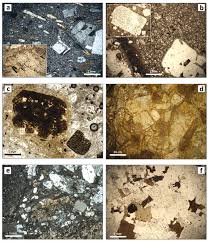
To study the texture of rocks, petrographers use various microscopes, including optical and electron microscopes. These tools allow for detailed analysis of rock sections, revealing the presence of minerals and their arrangement within the rock.
Sedimentary and Metamorphic Rocks
While igneous rocks are our focus here, sedimentary and metamorphic rocks also play crucial roles in understanding the Earth’s history. Sedimentary rocks form from the accumulation of sediments, while metamorphic rocks result from high-temperature and pressure transformations.
Petrographic Techniques
Several techniques are employed to study petrography, including:
- Thin Section Analysis: This involves cutting a thin section from the rock and examining it under a microscope.
- Scanning Electron Microscopy (SEM): SEM uses a focused beam of high-energy electrons to produce images of the rock’s surface.
- Raman Spectroscopy: This technique measures the interaction between the rock and light, providing information on its mineral composition.
Applications of Petrography
Petrography has numerous applications in various fields, including:
- Mining and Exploration: Petrographers help identify potential mineral deposits by analyzing rocks and minerals.
- Environmental Monitoring: By studying rocks and sediments, petrographers can monitor environmental changes and track the movement of contaminants.
- Archaeological Research: Petrography provides valuable insights into ancient civilizations by examining the rocks and minerals used in construction.
Career Opportunities
A career in petrography offers a range of opportunities, including:
- Research Geologist: Conducting field research and analyzing samples to advance our understanding of geological processes.
- Mineral Economist: Analyzing mineral deposits and predicting market trends.
- Conservation Scientist: Working with governments and industries to protect natural resources.
In conclusion, petrography is a fascinating field that seeks to understand the intricate details of rocks, minerals, and their textures. By studying these phenomena, we can gain insights into the Earth’s history, climate, and geological processes, ultimately enriching our understanding of our planet and its complexities.


