
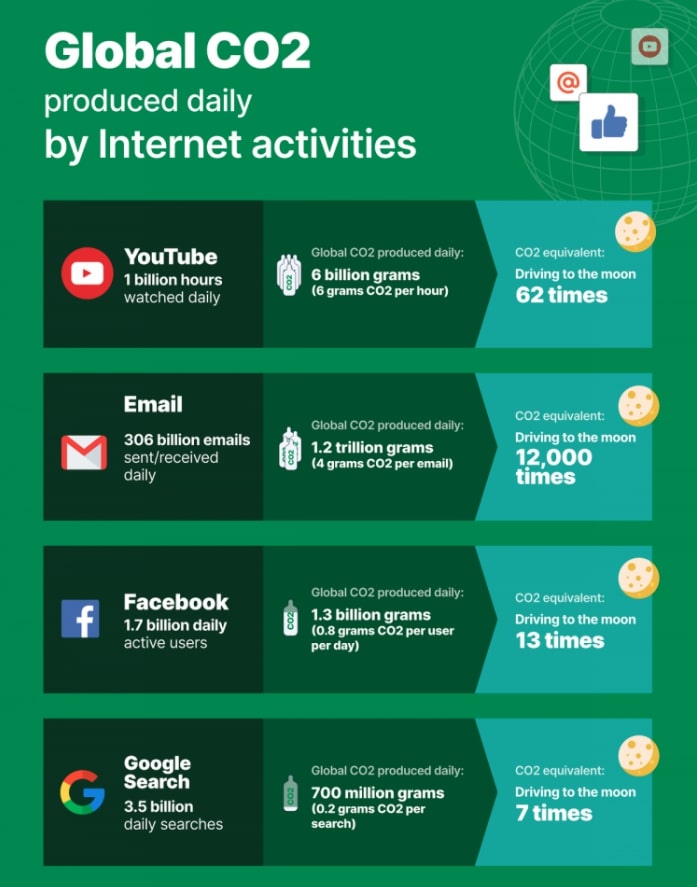
The Environmental Costs of Technology and Social Media
Environmental issues and the causes of air pollution are complex topics that often oversimplify important factors and considerations. Air pollution from plastic waste is certainly one of the most pressing issues to address, as well as the emissions of CO2 from gasoline or diesel-powered vehicles. However, sources of pollution go far beyond just these two areas, particularly when considering the indirect pollutants generated by the entire production chain and large-scale events.
Indirectly generated air pollution from energy consumption is another significant source. In this article, I’ll explain the environmental costs associated with technology and social media use. These “hidden” costs are often denied because we’re the first to deny them ourselves – as we can’t imagine living without our electronic devices, smartphones, and favorite social media platforms.
For this article, I drew data from ExpressVPN’s study on technology consumption, conducted in conjunction with last year’s Environmental Day on June 5th.
Household Electronics That Consume the Most Energy
The first important step is to be aware of which household electronics consume the most energy. By doing so, we can reason about how to rationalize their use and achieve significant economic savings.
Most households have these types of devices:
- Fixed air conditioning units: 216 kW per month
- Portable appliances for heating during winter months: 90 kW per month
- Dishwashers: 65.1 kW per month
- Electric water heaters: 46.8 kW per month
- Refrigerators and freezers: 35 kWh per month
- Clothes dryers: 25.5 kWh per month
- Washing machines: 19.5 kWh per month
We don’t have many surprises here, and these devices are ones that it’s difficult to give up without compromising the quality of our daily lives.
The Costs of Domestic Technology
The most interesting data from ExpressVPN is related to the various energy consumption generated by small “tech” devices, which together create significant energy consumption despite their small size.
Here are some intriguing examples:
- Hair dryers: 13.5 kWh/month
- Radios: 5.8 kW/month
- LED TVs: 2.8 kW/month (assuming usage of 3 hours per day)
- Gaming consoles: 4.2 kW/month (assuming 2 hours of use per day)
- Home stereos: 3 kW/month (assuming 2 hours of use per day)
- Wi-Fi routers: 7.2 kW/month (continuous use)
- Desktop computers: 10.8 kW/month (assuming 6 hours of use per day)
- Laptops: 9 kWh/month (assuming 6 hours of use per day)
- LCD monitors (17 inches): 7.2 kW/month (assuming 6 hours of use per day)
You’ve probably noticed how the monthly consumption is largely determined by usage frequency as well as device consumption.
A TV LED consumes 2.8 kW per month if we assume it’s used for 3 hours a day, but if the usage time doubles or we have multiple TVs in our home (which is the case for 90% of Italian households), the consumption increases exponentially.
The same goes for Wi-Fi routers that initially consume only 0.01 kWh but are left on continuously throughout the day, resulting in an energy consumption of 7.2 kW per month.
As computer usage and smart work continue to grow, monitors remain active all day, generating monthly energy consumption that can exceed 30 kW!
The Costs of Server Farms for Web Giants
Web corporations that offer popular web services like Google (search engine and YouTube) or Meta (Facebook and Instagram) consume enormous amounts of energy. The more we use their services, the more they need to increase their energy consumption.
The amount of electricity used by data centers powering Facebook and other large internet companies is difficult to calculate with precision due to a lack of transparency and technical complexities. Additionally, these companies often engage in renewable energy initiatives, which can complicate further our calculations of the environmental cost.
However, Facebook has provided some data on their own energy consumption. In 2020, for example, they reported using 5.4 terawatt-hours of electricity.
To calculate the cost of this energy, we need to know the average price of electricity in the United States. According to the International Energy Agency’s data, in 2020 the average price was around $0.10 per kWh.
Assuming Facebook pays an average rate, we can do a rough calculation:
5.4 terawatt-hours = 5,400,000,000 kWh
5,400,000,000 kWh * $0.10/kWh = $540,000,000
So, the estimated annual cost of energy for Facebook could be in the hundreds of millions of dollars.
Avoiding Waste and Producing Renewable Energy
To reduce energy consumption and pollution from energy production itself, we have two main options: avoid waste and produce renewable energy.
In the first case, being aware of our energy costs should serve as a good starting point and motivation. In the second case, the most promising solutions are those related to small-scale domestic solar panels.
This is clearly a small step, but it’s only through this that we can truly reduce our energy consumption and contribute to saving the environment.
The Economic Costs of Technology and Social Media
In addition to environmental costs, technology and social media use also come with significant economic costs. These costs are often hidden from view, as they do not directly impact our daily lives in the same way that environmental costs do.
One example is the cost of maintaining large-scale data centers, such as those used by web corporations like Facebook and Google. As mentioned earlier, these companies consume enormous amounts of energy, which can have significant economic costs.
Another example is the cost of producing new technology devices. The production process for smartphones, laptops, and other electronic devices requires significant resources, including energy and raw materials. These costs are often passed on to consumers in the form of higher prices.
The Human Impact of Technology
In addition to environmental and economic costs, technology also has a significant human impact. One example is the mental health effects of excessive social media use. Studies have shown that prolonged exposure to screens can lead to increased stress levels, anxiety, and depression.
Another example is the impact of technology on our physical health. Prolonged sitting in front of screens can lead to a range of health problems, including obesity, diabetes, and cardiovascular disease.
Conclusion
The environmental cost of technology and social media use is significant, yet often overlooked. By being aware of which household electronics consume the most energy, we can begin to make changes in our daily lives and save on energy costs. Furthermore, considering our increasing reliance on renewable energy sources can help us reduce our overall impact on the environment.
However, the economic and human costs of technology and social media use cannot be ignored. By understanding these costs, we can take steps to mitigate their negative impacts and create a more sustainable future for ourselves and future generations.
Frequently Asked Questions
-
How can I reduce my household’s energy consumption?
By being aware of which devices consume the most energy and making adjustments to their usage patterns, you can start making a positive impact. -
What are some ways to produce renewable energy at home?
Small-scale solar panels are an effective way to generate your own clean energy while reducing your reliance on public utilities. -
How much does it cost to maintain the energy consumption of large corporations like Facebook and Google?
With an estimated annual cost of hundreds of millions of dollars, the financial burden of maintaining high levels of energy consumption is substantial. -
What can I do as a consumer to reduce my carbon footprint?
Making small changes in your daily routine, such as using energy-efficient appliances or turning off electronics when not in use, can make a significant impact on reducing greenhouse gas emissions. -
Can technology help us mitigate climate change?
Yes, technology plays an essential role in reducing our environmental impact by providing clean and sustainable alternatives to traditional fossil fuels. -
What is the most effective way to promote the adoption of renewable energy sources?
A combination of policy incentives, education, and public awareness campaigns can effectively encourage individuals and organizations to adopt renewable energy sources. -
How can social media platforms contribute to reducing energy consumption?
By incorporating features that promote energy-efficient usage and encouraging users to share their own sustainable practices, social media platforms can play a vital role in raising awareness about the importance of energy conservation. -
What are some potential economic benefits of transitioning to renewable energy sources?
While there may be initial costs associated with investing in renewable energy technologies, the long-term economic benefits can include reduced energy costs, increased energy security, and new job opportunities in the clean tech sector.


