
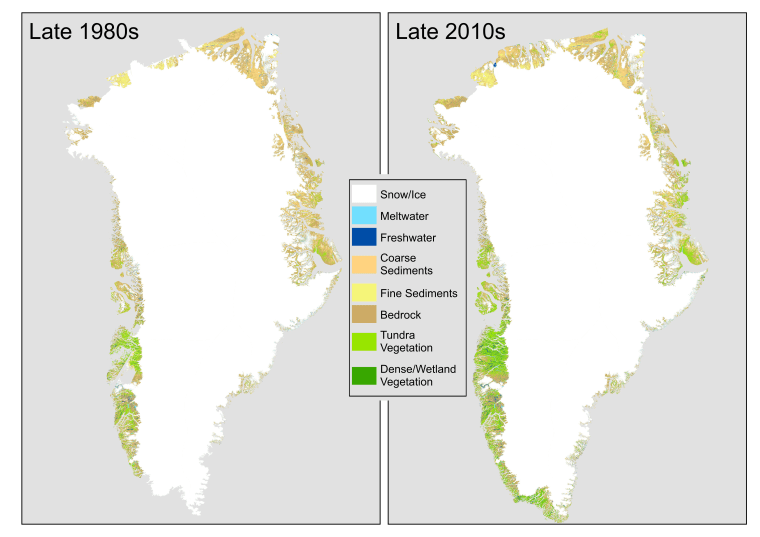
As we become increasingly aware of the signs our planet is sending us, it’s no wonder we’re taking a closer look at the transformations occurring in various regions, particularly those most sensitive to climate change like arid and polar zones. It’s only natural that an international team of researchers would ask how Greenland is changing, especially its ice sheet.
Understanding the Study
The study focuses on a pressing issue that has been ongoing for decades, but delves into data spanning up to 120,000 years. Published in Nature Communications, the research team includes those from the University of Milano-Bicocca. This approach isn’t new; however, this time it’s applied to studying ice sheet variations at Greenland’s eastern edge by examining the particles present in a glacier core.
Let’s dive deeper into how these researchers arrived at their findings with their study titled “Ice core dustparticle sizes reveal past ice sheet extent in East Greenland”.
The analyzed glacier core was 584 meters deep and extracted from Scoresby Sund, a region known for its unique geography, far from the ice cap and highly susceptible to marginal glacial oscillations. This area is perfect for such studies.
Discoveries
Analyzing mineral dust particles transported by winds from the proglacial regions over the past 120,000 years has allowed researchers to identify different phases of the ice sheet’s life cycle, including brief periods of limited extent and extended periods where it was much larger. When the ice sheet was almost absent, the land was exposed to air, which carried wind-borne particles that were trapped in the glacier core.
Thanks to precise dating of the glacier core, researchers have concluded that the ice sheet grew during the early stage of the last glacial period and progressively retreated during the first part of the current interglacial period (the Holocene). Notably, contrary to what was previously assumed, there weren’t significant changes in the ice sheet’s extent during the most recent glaciation period, even during periods characterized by rapid climate warming.
This study is interesting from other angles as well, for example studying the effects of dispersed particles on climate and assessing the impact of glacier melting on sea level rise.
Greenland’s Ice Sheet
Having understood how valuable glaciers are in providing centuries-old information, let’s take a closer look at the characteristics of ice sheets. By definition, an ice sheet is a continental-scale mass of ice covering a wide area of land, spanning more than 50,000 square kilometers.
The Greenland ice sheet is one of only two remaining ice sheets on Earth, the other being in Antarctica, but there were many more in the past. Even small glaciers are referred to as capes or capes de glace and are smaller masses of glacier ice that feed several glaciers.
How Old are Ice Sheets?
Ice sheets are relatively young; the Antarctic ice sheet formed from a small cap glaciale beginning in the first Oligocene, and by the end of it, it covered almost all of Antarctica. Greenland’s ice sheet emerged during the late Pliocene but grew rapidly with its first continental glaciation. This rapid growth explains why we find well-preserved fossils of plants that once thrived in what is now Greenland.
Greenland’s Role in Climate Change
Looking at long-term temperature fluctuations, it becomes clear that ice sheets play a significant role, especially when considering the ocean temperatures and overall planetary temperature. When an ice sheet forms, it releases latent heat; conversely, as it melts, it absorbs heat from oceans.
Currently, Greenland has lost some of its mass, though not as much as previously thought based on this study. However, according to the Intergovernmental Panel on Climate Change (IPCC), the loss of glacial ice in both Antarctica and Greenland contributes to sea level rise, approximately 0.2 mm annually from 1993 through 2003. This trend seems concerning and accelerating when considering global warming.
Where is Greenland Located?
To pinpoint Greenland on a map and keep an eye on it, let’s take a closer look at its location. Known as the “Land of Men” in the local tongue and “Greenland” or “Terra Verde” in Danish, this island lies in the far north of the Atlantic Ocean between Canada to the west, Iceland to the southeast, the Arctic, and the Arctic Ocean to the north.
Geographically, it belongs to the North American plate but politically, it’s part of the Kingdom of Denmark. Excluding Australia, Greenland is considered the world’s largest island while also being one of the least densely populated regions.
Conclusion
Greenland’s ice sheet holds much significance for climate change research and understanding our planet’s recent past. As we delve deeper into how this ice sheet is changing due to global warming, it becomes evident that Greenland plays a pivotal role in maintaining Earth’s temperature balance.
Stay tuned for more updates on climate-related topics.
Frequently Asked Questions
-
How does the study of the Greenland ice sheet contribute to our understanding of climate change?
The study provides crucial insights into past climate fluctuations and helps researchers understand how greenhouse gas emissions impact global temperatures. -
What is the significance of the 120,000-year data analyzed in this study?
This time frame allows researchers to pinpoint climate events that occurred millions of years ago, providing a comprehensive understanding of Earth’s history. -
How does melting of ice sheets affect sea levels?
The melting of ice sheets contributes significantly to global sea level rise due to the release of trapped water and subsequent absorption by oceans. -
Can you explain why Greenland’s calotte is losing mass at an alarming rate?
While this study indicates some loss, the rate isn’t alarmingly rapid. However, climate change remains a pressing concern for all ice sheet systems worldwide.
-
What led to the formation of the ice sheets in the past?
The exact causes are still debated among scientists but it’s believed that natural climate fluctuations and changes in global ocean currents played a significant role. -
Can you compare the effects of melting glaciers versus land warming on sea levels?
Both processes contribute to sea level rise, but their impacts differ due to various factors including ice sheet dynamics and oceanic circulation patterns.
-
What does this study mean for future climate predictions?
Understanding past changes in the Greenland ice sheet can help researchers improve models predicting global temperature fluctuations and associated impacts on sea levels. -
Can you tell us more about other regions of Earth that are sensitive to climate change like Greenland?
Regions such as arid zones, polar areas, and coastal ecosystems around the world are highly susceptible to climate-related changes due to their unique geographical characteristics and adaptations.
In conclusion, studying the Greenland ice sheet provides critical information on past climate conditions and helps us better understand its role in maintaining Earth’s temperature balance.


