
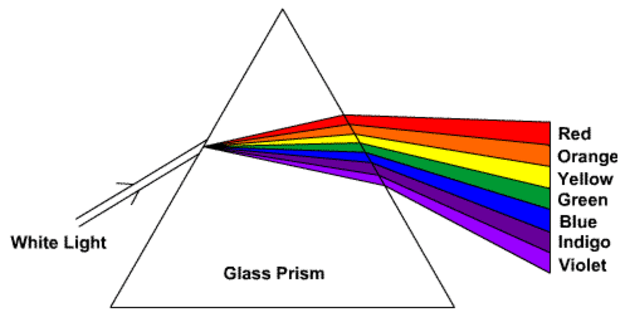
As we gaze upon the world around us, it’s easy to take for granted the intricate dance of light and color that pervades our daily lives. But what if I told you that there’s a “magical” tool that can reveal the hidden secrets of light, its composition, and how we can harness it? Enter the Prisma di Newton, a centuries-old experiment that has captivated scientists and artists alike.
The Life and Times of Isaac Newton
Isaac Newton was a visionary physicist who laid the foundation for our modern understanding of light. His groundbreaking work on optics, as outlined in his treatise Opticks, established him as one of the most influential minds in history. But Newton’s contributions didn’t stop there. He also made significant strides in understanding the behavior of color and its relationship to light.
Born on January 4, 1643, in Woolsthorpe, England, Newton was a child prodigy who showed an early interest in mathematics and science. His father, also named Isaac, died before his birth, leaving Newton’s mother to raise him and his half-sister. Despite the challenges he faced, Newton went on to attend Trinity College, Cambridge, where he developed his passion for physics and mathematics.
The Birth of Modern Optics
Newton’s prismatic experiment marked a turning point in modern optics. By shining white light through a prism, he discovered that it was possible to separate the colors of the spectrum, revealing their unique properties. This observation had far-reaching implications for our understanding of light and its interactions with matter.
In his book Opticks, Newton wrote extensively about his experiments with prisms and the behavior of light as it passes through them. He argued that white light is composed of a mixture of colors, which can be separated and then recombined to form white light once again. This idea challenged the prevailing theories of his time and paved the way for modern physics.
The Prism: A Tool for Discovery
So how does the Prisma di Newton work? In simple terms, when white light passes through a prism, it is refracted, or bent, into its individual colors. These colors can then be recombined to form white light once again. This process is known as dispersion.
The prism is a crucial component of the Prisma di Newton experiment. Its shape and size determine the angle at which light is refracted, allowing us to separate the colors of the spectrum. By adjusting the angle of the prism, we can observe different ranges of wavelengths and gain insight into the behavior of light.
The Role of Refraction
Newton’s observations on refraction led him to propose that color was not an inherent property of objects, but rather a characteristic of light itself. He argued that each color had its own unique refractive index, which determined how it interacted with matter. This idea challenged the prevailing theories of his time and paved the way for modern physics.
Refraction is the bending of light as it passes from one medium to another. In the case of the Prisma di Newton, white light passes from air into a prism, causing it to bend and separate into its individual colors. The angle at which this occurs determines the order in which the colors are separated.
The Theory of Corpuscular Light
Newton’s work on the Prisma di Newton also led to the development of his corpuscular theory of light. According to this concept, light is composed of tiny particles called corpuscles that travel at high speeds and interact with matter in predictable ways. This idea was revolutionary for its time and laid the foundation for later developments in optics.
In his book Opticks, Newton wrote about his experiments with corpuscular motion, where he observed how small particles could move through space and interact with other objects. He proposed that light was composed of these tiny particles, which he called “corpuscles.” While this idea has been largely discredited by modern science, it marked an important step in the development of our understanding of light.
Teaching Light to Young Minds
So how can we make the Prisma di Newton accessible to young minds? One fun experiment involves creating a “disco” by dividing a CD into seven color sectors, each corresponding to a different color of the spectrum. When the CD is rotated, the colors blend together to form white light once again.
This experiment illustrates the principles of dispersion and refraction, demonstrating how light can be separated and recombined to form different colors. It’s an engaging way for young people to learn about light and its behavior, and it has been used in many educational settings around the world.
The Spoken Language of Light
Newton’s work on the Prisma di Newton also sparked an interest in the language of light. By studying the behavior of colors and their relationships, scientists can gain insight into the underlying structure of light itself. This “spoken language” holds secrets to the natural world, waiting to be deciphered by curious minds.
In modern physics, this concept is known as spectroscopy, where scientists study the interaction between matter and electromagnetic radiation. By analyzing the spectrum of a particular substance, we can gain information about its chemical composition and physical properties.
Exploring the Realm of Color
But what about color? How do we define it, and how does it relate to light? Newton’s work on the Prisma di Newton laid the groundwork for our modern understanding of color. By distinguishing between warm and cool colors, scientists can better understand the nuances of the visible spectrum.
Color is a complex phenomenon that has fascinated artists and scientists for centuries. While we often associate color with visual perception, it also plays a crucial role in many scientific contexts, such as biology, chemistry, and physics.
Unraveling the Mystery of Light
The Prisma di Newton remains an essential tool for unraveling the mysteries of light. Its secrets have captivated scientists and artists for centuries, inspiring new discoveries and artistic expressions. As we continue to explore the realm of color and light, we honor the legacy of Isaac Newton and the groundbreaking work that continues to shape our understanding of the world around us.
Case Studies: The Applications of the Prisma di Newton
- Optical Fibers: The principles of dispersion and refraction developed in the Prisma di Newton experiment have been applied in the development of optical fibers, which transmit data as light signals through thin glass or plastic cables.
- Color Separation: The separation of colors using a prism has practical applications in fields such as textiles, where color separation is used to create new shades and hues.
- Artistic Expression: The Prisma di Newton experiment has inspired many artists and musicians, who use the principles of light and color to create innovative works of art.
Conclusion
In conclusion, the Prisma di Newton remains a fascinating tool for understanding the secrets of light and its behavior. Its principles have been applied in numerous fields, from optics to textiles, and continue to inspire new discoveries and artistic expressions.
By exploring the wonders of the Prisma di Newton, we honor the legacy of Isaac Newton and the groundbreaking work that continues to shape our understanding of the world around us. Whether you’re a scientist, artist, or simply curious about light and color, this ancient experiment remains an essential tool for unraveling the mysteries of the natural world.
Frequently Asked Questions
- What is the Prisma di Newton?
The Prisma di Newton is a centuries-old experiment that reveals the secrets of light and its composition. - Who discovered the Prisma di Newton?
Isaac Newton was the first to conduct specific studies on the spettro visibile, which led to the development of his theory of light. - What is dispersion?
Dispersion refers to the process by which white light passes through a prism and separates into its individual colors. - How does refraction work in the Prisma di Newton?
Refraction occurs when white light passes through a prism, causing it to bend and separate into its individual colors. - What is corpuscular theory of light?
The corpuscular theory of light proposes that light is composed of tiny particles called corpuscles that travel at high speeds and interact with matter in predictable ways. - How can we create a “disco” using the Prisma di Newton?
To create a “disco,” divide a CD into seven color sectors, each corresponding to a different color of the spectrum. Rotate the CD to blend the colors together and observe the resulting white light. - What is the significance of the Prisma di Newton in modern optics?
The Prisma di Newton marked a turning point in modern optics, establishing the foundations for our understanding of light and its interactions with matter. - Can we harness the power of the Prisma di Newton?
While the Prisma di Newton cannot be directly harnessed as an energy source, its principles continue to inspire innovative applications in fields such as optics, materials science, and art.
Glossary
- Corpuscles: Tiny particles that make up light according to Newton’s corpuscular theory.
- Dispersion: The process by which white light passes through a prism and separates into its individual colors.
- Refraction: The bending of light as it passes from one medium to another.
- Spectroscopy: The study of the interaction between matter and electromagnetic radiation.
- Spettro visibile: The visible spectrum of light, which was studied by Newton in his work on the Prisma di Newton.
References
- Newton, I. (1704). Opticks: Or, a Treatise of the Reflections, Refractions, Inflections and Colours of Light.
- Descartes, R. (1637). Dioptrics.
- Hooke, R. (1665). Micrographia.
Further Reading
- Optics: A comprehensive textbook on optics, covering topics such as wave propagation, reflection, refraction, and diffraction.
- Color Theory: A guide to understanding the principles of color, including the properties of light and its interaction with matter.
- Spectroscopy: A review of spectroscopic techniques and their applications in various fields.
Online Resources
- Khan Academy: Interactive lessons on optics and spectroscopy.
- MIT OpenCourseWare: Free online courses on optics, including lecture notes and assignments.
- Scientific American: Articles on the latest developments in optics and spectroscopy.


