
The Increasing Problem of Mediterranean Sea Jellyfish
As the number of jellyfish colonies in the Mediterranean Sea continues to rise, experts believe that climate change is the main factor behind this trend. With warmer water temperatures, these gelatinous creatures can reproduce more easily, leading to an increase in their populations.
But why are jellyfish becoming a bigger problem for our oceans? The answer lies in human activities that harm marine ecosystems. In addition to climate change, factors such as pollution, erosion, land use, and certain types of fishing contribute to the proliferation of these animals.
These activities may seem unrelated to jellyfish life cycles, but they can have devastating effects on entire marine environments. For example, when a type of fishing is practiced that destroys the seafloor, where no other aquatic fauna live, jellyfish can thrive in their sessile form (polyp).
If you’re looking for mortal jellyfish species in Italy, be prepared to find very little. Only recently has the Mediterranean Sea, which borders Italy’s coastlines, become home to more dangerous species.
Common Species of Jellyfish in the Mediterranean
The following are some of the most common jellyfish found in the Mediterranean:
- Pelagia noctiluca, known as the “luminous jellyfish”
- Rhizostoma pulmo, also known as the “polyp of the sea”
- Cotylorhiza tubercolata, or the “tubercolated jellyfish”
- Valella valella, also referred to as the “barque of St. Peter”
In recent years, it has become increasingly common to see non-native species such as Physalia physalis, or the “Caravela portuguese”. This is not actually a jellyfish, but rather a siphonophore, which is a colony of organisms living in symbiosis with each other.
The Caravela Portuguese is considered one of the most dangerous jellyfish in the Mediterranean and our waters. It releases toxins that cause intense pain in humans, but only rarely causes cardiac arrest.
The Luminous Jellyfish
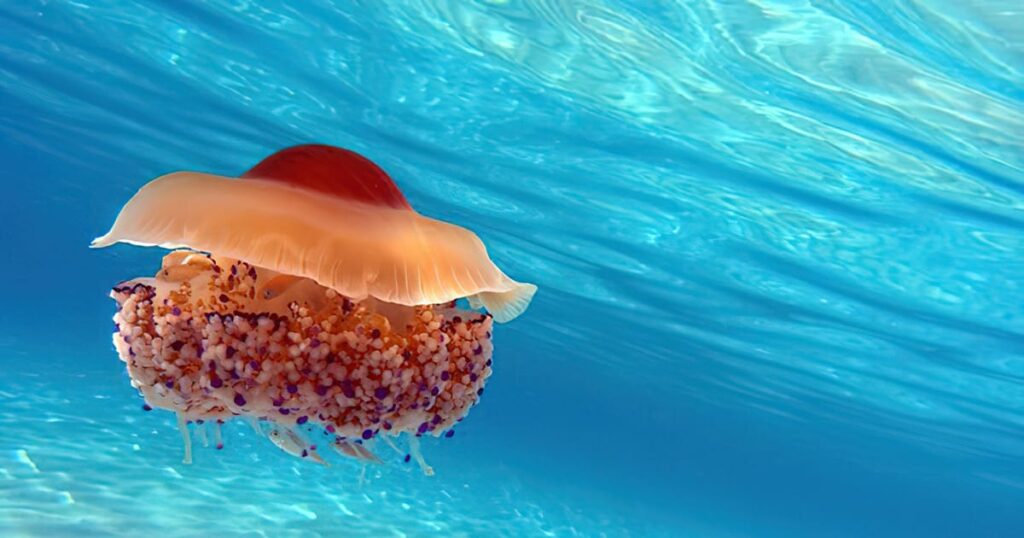
The luminous jellyfish (Pelagia noctiluca) prefers the waters of the Tyrrhenian Sea but can be found in various parts of the Mediterranean. This jellyfish is often described as having a reddish hue and is shown in the image above for its appearance.
This species, like many other jellyfish, exhibits bioluminescence when stimulated by the motion of their prey or predators, which emits a blue-green light that can be seen on the water’s surface.
Polyp of the Sea
Despite its intimidating appearance, this jellyfish is not very threatening to humans: its tentacles are not particularly irritating. Known as the polyp of the sea (Rhizostoma pulmo), it can be found throughout the Mediterranean but is more easily spotted in the Adriatic and Ionian Seas.
In particular, it’s most frequently encountered during late summer and early fall. This jellyfish has an opalescent semi-spherical cap that tends to fade into transparency with the edges frayed blue-violet.
Medusa Tubercolata (Cassiopea Mediterraneana)
The tubercolated jellyfish (Cotylorhiza tubercolata) or Cassiopea Mediterranean reaches a diameter of 30 cm. It’s quite noticeable and despite its large size, this species is not particularly irritating to humans.
This species can be found in the warm waters of the Mediterranean Sea and can grow up to 15 feet tall when at its most prominent height.
Barchetta di San Pietro (Velella velella)
This small hydromedusa often washes up after storms and has earned the nickname “barque of St. Peter” due to its triangular crest resembling a sail. Thanks to its “sail”, this jellyfish is able to move across the water’s surface using wind power.
While not particularly deadly, close contact with this species can be unpleasant, but its toxins cannot penetrate human skin. The color of its tentacles has led it to be referred to as “blue jellyfish”.
Cubomedusa: A Common Species in the Adriatic
The Carybdea marsupialis is the only cubomedusa present in the Mediterranean Sea. Although it was once not recorded in Italian waters, a significant increase in sightings of this species has been noticed over the past decade along Spain’s and Italy’s coasts.
If you’re searching for deadly jellyfish species in Italy, Carybdea marsupialis could potentially raise some concern. Is it deadly? Not particularly. The toxin released by this species can cause severe burns on humans and even put their lives at risk. The reason is not directly related to the toxin but rather potential allergic reactions triggered by certain particles within the venom of the animal.
What to Do in Case of a Jellyfish Stinging
In case you get stung by jellyfish, the best course of action can be found in our article about jellyfish stings.


