
Introduction
In a world of large and impressive horses, it’s easy to overlook the smaller ones. But the Pottok horse is anything but small in terms of its character, features, and historical significance. Originating from the Basque Country, both from the Spanish side (Hegoalde) and the French side (Iparralde), this breed has become a true icon in the world of equine history.
Origins
But where did this tiny but mighty horse come from? According to historians, the Pottok horse was also used by the Germanic people of the Visigoths. One thing is certain: it’s very old and dates back to small horses that roamed the area millions of years ago. Recent discoveries suggest that its ancestors even date back to the Paleolithic period.
To understand the origins of the Pottok horse, let’s take a look at some ancient rock art paintings found in the Isturitz and Oxocelhaya caves. These paintings depict horses that are strikingly similar to the current Pottok breed. This not only confirms their shared ancestry but also provides us with valuable insights into the evolution of this breed.
These early depictions showcase horses with characteristics such as a compact body, small size, and robust build, all features that define the modern-day Pottok horse. The artwork also highlights the importance of these small horses in the daily lives of ancient cultures.
Characteristics
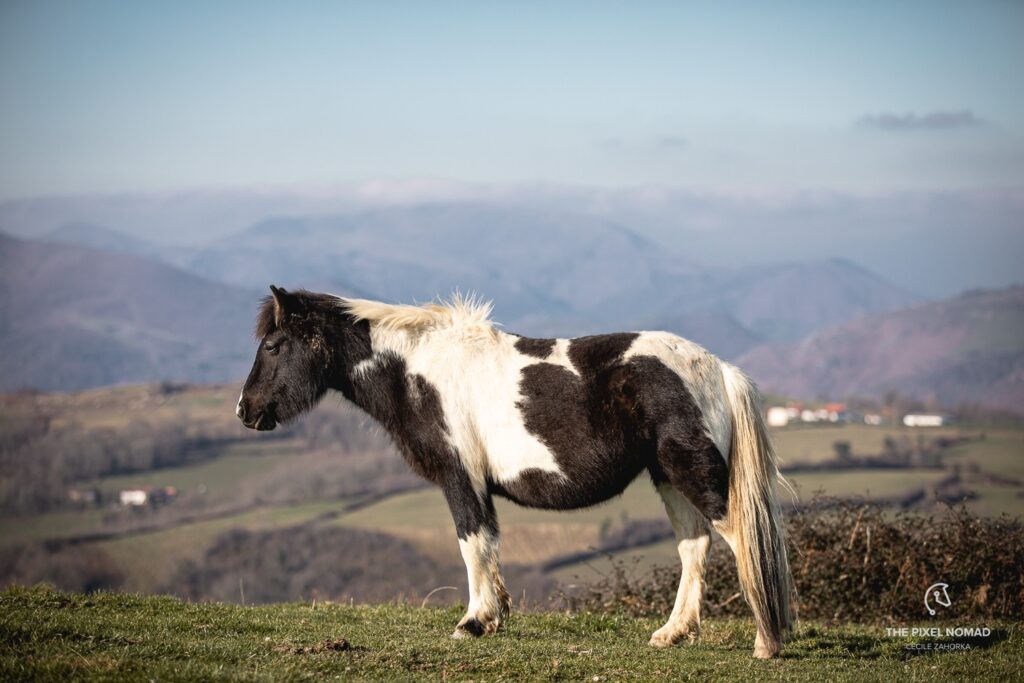
So, what makes a Pottok horse? On average, an example of this breed reaches a height of around 124 cm (49 inches), less for mares, and weighs slightly more than 200 kg (441 pounds). The Pottok horse has a mesomorphic structure and simple lines. Its head fits harmoniously with the rest of the body, featuring a concave profile, flat forehead, wide nostrils, and thick lips.
The eyes are expressive and almost almond-shaped, dark in color, and perfectly placed to gaze out at the world. The mane is wispy, while the ears have smaller dimensions. Moving on to its legs, they’re robust and adapted for mountain walking, with prominent tendons, strong garrettes, and short stinches.
The coat can vary from dark bay to chestnut, adding a touch of elegance to this already striking breed. But what really sets the Pottok horse apart is its unique size – small enough to navigate tight spaces but powerful enough to tackle even the toughest terrain.
Character
So, what’s it like to be a Pottok horse? Tranquil but determined and full of energy, this horse is rustic yet at the same time also docile. It loves working and is very committed, with a hidden nobility beneath its “mountain fur” that makes it robust and resistant both characteristically and physically.
Despite their small size, Pottok horses possess an unyielding spirit, showcasing incredible strength and resilience in challenging environments. They are known for their intelligence, agility, and remarkable adaptability to different climates and terrains.
Their strong physical build and sturdy legs enable them to traverse uneven terrain with ease, demonstrating their remarkable ability to navigate through dense forests, rugged mountains, or even deserts. This impressive physical prowess is complemented by a calm and gentle nature, making them an ideal choice for various riding activities.
Attitudes
In the past, Pottok horses were used extensively in mines, particularly in France and England. They also carried out agricultural work or acted as pack animals or slaughterhouse workers. For several centuries, they’ve been invaluable allies for contrabandiers of the Basque Country and the Pyrenees Eastern region.
Today, thanks to the protection and preservation of horse breeds in France, Pottok horses have become saddle horses, suitable for children to introduce them to equestrianism or for mountain tourism. It’s a testament to their versatility and adaptability.
The role of these small horses has also played a significant part in shaping the culture and traditions of the Basque people. As pack animals, they carried goods across vast distances, facilitating trade between neighboring towns and cities.
Breeding
Finding breeding stock for this rare breed can be challenging, particularly in Italy. However, there are opportunities to find them near the Basque Country or even free in nature, where they’ve developed strong instinctive defense and survival behaviors.
In groups of up to 30 individuals at most, Pottok horses create a social network that’s essential for their well-being. Smaller groups form during autumn and winter, with around 5-10 horses per group. It’s heartening to know that conservation efforts are underway to protect this precious breed.
Breeding Programs
The breeding of Pottok horses involves careful planning, ensuring the genetic diversity and health of the population. Efforts by horse breeders aim to create a balanced and healthy gene pool, allowing the breed to thrive in the long term.
Conservation organizations have launched various breeding programs to help preserve this rare breed. These initiatives focus on selective breeding, with a primary goal of maintaining the genetic integrity of the Pottok horse while also promoting its use as a pack animal or saddle horse.
Challenges
Despite their impressive resilience and adaptability, Pottok horses still face numerous challenges in the modern world. Habitat loss and fragmentation have led to reduced grazing areas, making it harder for these small horses to survive naturally.
Climate change has also had an impact on the breed’s distribution and adaptation patterns, forcing them to adapt more quickly to changing environmental conditions.
Additionally, competition from larger breeds and market pressures can pose significant threats to the survival of this rare breed. Therefore, conservation efforts are crucial in safeguarding the Pottok horse for future generations.
Conclusion
The Pottok horse is more than just a small breed – it’s a symbol of resilience, adaptability, and strength. With its rich history, unique characteristics, and robust features, this tiny but mighty breed has captured the hearts of many equine enthusiasts.
As we continue to learn more about this incredible breed, let’s keep in mind that there’s still so much to discover and appreciate about the Pottok horse.
FAQs
- What is the average height of a Pottok horse?
The average height of a Pottok horse is around 124 cm (49 inches).
- How much do Pottok horses weigh?
Pottok horses typically weigh between 200 kg (441 pounds) and more.
- What is unique about the Pottok horse’s legs?
Their legs are robust, adapted for mountain walking with prominent tendons, strong garrettes, and short stinches.
- Can Pottok horses be used as pack animals?
Yes, they were historically used for pack work, showcasing their strength and versatility.
- What is the current status of Pottok horse breeding?
Breeding stock can be found near the Basque Country or in Italy, but conservation efforts are underway to protect this rare breed.
- How many individuals does a group of Pottok horses typically form?
Groups of up to 30 individuals at most, with smaller groups during autumn and winter.
- Can children learn from riding Pottok horses?
Yes, thanks to the preservation efforts, saddle horse Pottok horses are now suitable for children to introduce them to equestrianism.
- What is the typical color of a Pottok horse’s coat?
The coat can vary from dark bay to chestnut, with some individuals displaying unique markings or patterns.


