
As our only natural satellite, the moon has captivated human imagination for centuries. With its majestic presence, it is no wonder that scientists and astronomers have been studying the moon since ancient times. However, a deeper understanding of the moon’s characteristics, movements, and phases began to emerge only in the 1950s with the launch of the Soviet Union’s Luna 3 spacecraft.
In this article, we will delve into the fascinating world of the moon, exploring its unique features, orbital movements, and lunar cycles. From its proximity to Earth to its geological composition, we’ll examine what makes our celestial neighbor so intriguing.
Characteristics of the Moon
The moon is approximately 384,000 kilometers away from Earth, with a spherical shape that’s remarkably close to perfection. Its surface area is roughly equivalent to that of the North American continent, while its diameter is about one-third of Earth’s. The moon’s radius measures 1,738 kilometers, and its volume is about 44 times smaller than our planet’s.
The moon’s gravitational force is significantly weaker than Earth’s, which means objects on its surface weigh less. To put this into perspective, an object that weighs 1,000 grams on Earth would only weigh around 160 grams on the moon. This reduced gravity also affects the way liquids and gases behave on the lunar surface.
The moon’s surface reflects about 7% of the sun’s light, with the remaining portion being absorbed by the soil. During the day, this results in intense heating, causing temperatures to soar up to 120-130°C (250-260°F). Conversely, at night, the lack of atmosphere allows heat to escape rapidly, leading to rapid cooling and temperatures plummeting to -150°C (-238°F).
The moon’s surface is covered with a fine dust that contains high concentrations of aluminum and radioactive elements. Two distinct color patterns are visible: dark regions corresponding to flat areas reminiscent of ancient lakes, and bright regions composed of rocks that reflect light more efficiently.
Geologically, the moon features two types of landscapes: dark and light. The dark regions contain flat plains similar to those depicted by Galileo in his lunar map, which were thought to be bodies of water. These areas have been named oceanus, mare, lacus, and palus. In contrast, the bright regions are characterized by high reflectivity and are home to volcanoes that rise up to 6,000 meters (20,000 feet), with craters of varying sizes ranging from a few dozen meters to 250 kilometers in diameter.
Movements of the Moon
The moon’s movements can be broadly categorized into three main types: rotation around its axis, revolution around Earth, and translation along with Earth around the sun.
As the moon rotates on its axis, it faces Eastward toward the West, mirroring Earth’s own rotation. This process takes 27 days and about 8 hours to complete. The resulting period is known as a sidereal month or lunar month. During this time, the moon also orbits Earth, which means that, apart from the rotation, it travels around our planet.
However, because Earth is also moving around the sun, the moon needs an additional journey of more than two days to return to its original alignment with the sun and Earth. This combined journey lasts approximately 29 days and 13 hours and is known as a synodic month or lunar cycle.
The moon’s orbit is not a perfect circle but rather an ellipse, which means that it doesn’t maintain a fixed distance from Earth at all times. When it’s closest to our planet (perigee), the moon is about 356,000 kilometers away, while when it’s farthest (apogee), it is approximately 407,000 kilometers from Earth.
As the moon moves around both Earth and the sun, it forms an epicicloidal path that traverses various points on Earth’s orbit. This path is completed about 24-25 times per year.
Phases of the Moon
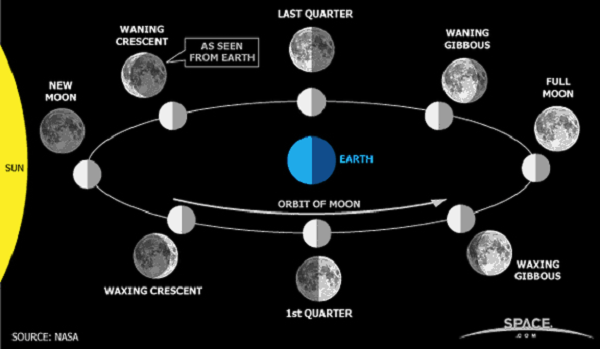
Throughout its monthly journey, the moon undergoes four distinct phases due to its changing position relative to the sun and our planet. These phases are:
- Conjunction: When the moon is between the sun and Earth.
- Opposition: When the moon appears on the opposite side of the sun from Earth.
- Quadrature (First and Last Quarters): When the moon forms a 90-degree angle with the sun and Earth.
During conjunction, the moon is not visible because its side facing Earth is in shadow. Following this phase, the moon begins to appear as a sliver of light, growing larger until it reaches full illumination, marking the beginning of the plenum or full lunar cycle. After about 7.5 days, the first quarter appears, with half of the moon’s illuminated surface visible from Earth.
Subsequently, the moon enters its opposition phase, when the entire illuminated side faces our planet. This marks the peak of illumination and is called a plenilunio or full lunar cycle.
The final phase in this sequence occurs when the moon has lost about 50% of its illumination, resulting in an ever-decreasing crescent shape, also known as a luna calante, until it disappears from view again at conjunction.
Understanding Lunar Cycles
Lunar cycles are influenced by various astronomical events and planetary alignments. The most significant factors include:
- Sidereal Month: A lunar cycle that occurs every 27.3 days, reflecting the moon’s rotation on its axis.
- Synodic Month: A lunar cycle that occurs approximately every 29.5 days, accounting for Earth’s motion around the sun and the moon’s orbit around our planet.
- Lunar Cycle Lengths: The length of a lunar cycle can vary from approximately 27.3 to 30.4 days due to minor variations in Earth’s rotation and the moon’s orbital path.
Scientific Discoveries and Exploration
The study of the moon has led to numerous scientific discoveries and space exploration missions. Some notable achievements include:
- Lunar Landing: NASA’s Apollo program successfully landed astronauts on the moon’s surface between 1969 and 1972.
- Moon Rocks: The Apollo missions returned over 800 pounds of moon rocks and soil, providing scientists with valuable insights into the moon’s geological composition and formation.
- Seismometers: During the Apollo missions, seismometers were installed on the moon’s surface to study lunar earthquakes and internal structure.
- Lunar Laser Ranging: Scientists have been using retroreflector arrays left on the moon’s surface by the Apollo astronauts to measure the moon’s distance from Earth with incredible accuracy.
Future Missions and Exploration
As space exploration continues to advance, we can expect new missions to explore the moon in greater detail:
- Artemis Program: NASA plans to send the first woman and the next man to the moon by 2025 as part of its Artemis program.
- Private Space Missions: Companies like SpaceX and Blue Origin are developing lunar landing capabilities, paving the way for private space exploration.
- Lunar Resource Utilization: Scientists aim to harness resources on the moon, such as helium-3 for nuclear fusion, to support future human settlements.
Conclusion
The fascinating world of the moon offers countless mysteries waiting to be unraveled by scientists and astronomers. From its unique characteristics to its complex orbital movements and lunar cycles, the moon remains an enigmatic presence in our solar system. By continuing to explore and study this celestial neighbor, we can deepen our understanding of its role in shaping Earth’s history and expanding our capacity for space exploration.
Additional Resources


