
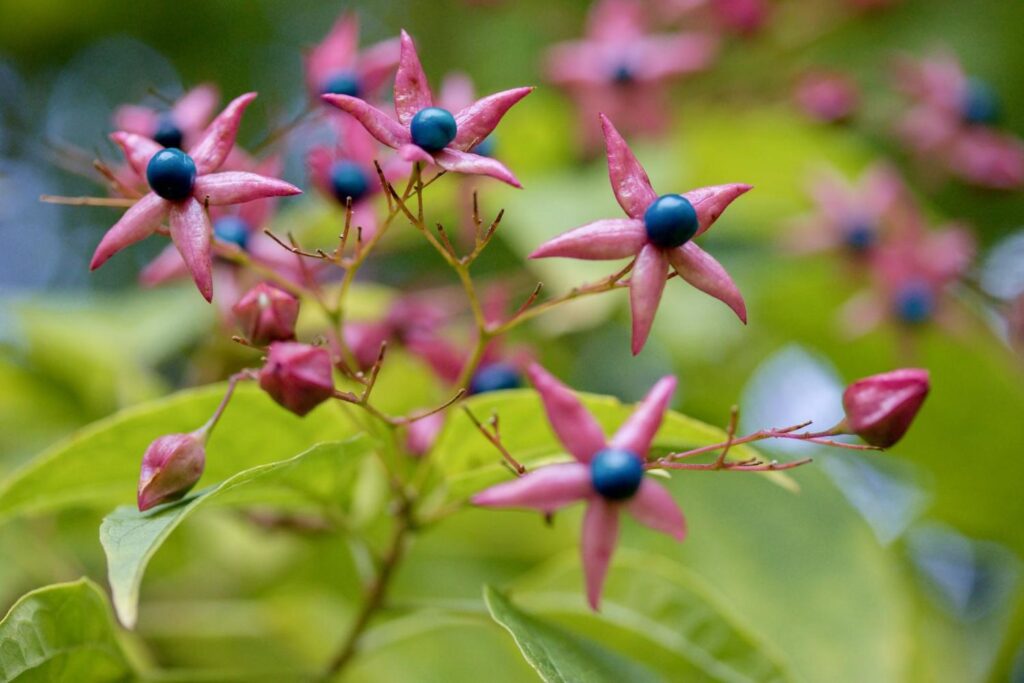
Clerodendrum is a name that may be challenging for non-English speakers, but it’s worth learning because it refers to a flowering plant with delightful presence, a compact shrub that originates from the East but has adapted well to our climate.
You can find Clerodendrum in Italian gardens, parks, or even urban areas. In this article, we’ll delve deeper into its different varieties and provide guidance on how to care for them, ensuring you can enjoy their beauty and fragrance for years to come.
Clerodendrum Varieties: An Overview
There are over 200 species of Clerodendrum, but we’ll focus on two main types: Clerodendrum trichotomum and Clerodendrum bungei. These varieties have distinctive features that make them popular among gardeners.
Clerodendrum trichotomum
This is the most widely known variety of Clerodendrum. It’s a small tree that grows up to 6 meters tall, with gray branches and lobed leaves that are 20 cm long. The flowers are white, sometimes with pink or purple shades, and emit a strong fragrance. The berries are red and contain a black seed.
There are two sub-varieties of Clerodendrum trichotomum: ‘Fargesii’ and ‘Carnival’. The ‘Fargesii’ variety has bronze-colored leaves, white flowers, and abundant fruit, while the ‘Carnival’ variety has blue-green leaves with yellow-gray margins.
Clerodendrum bungei
This variety is also resistant to cold temperatures, tolerating as low as -10°C. It originated in regions such as China, Himalaya, Taiwan, and Vietnam. Clerodendrum bungei grows up to 2.5 meters tall and has many branches. It can be grown as a shrub or an ornamental tree.
The leaves of Clerodendrum bungei are also heart-shaped and decidual, with reddish-brown hairs on the underside. The small flowers have a star shape and are often pink-colored. In late July or early August, large clusters of white flowers form, resembling a massive pink cloud.
Cultivation: Tips and Tricks
While growing Clerodendrum can be challenging, once you learn how to care for it, it’s relatively easy. The key is to find the right exposure and provide initial care.
Exposure
Place your Clerodendrum in a sunny spot with at least half-shade or full sun. It’s essential to provide enough light, but not too much, as excessive sunlight can dry out the leaves. In colder regions, protect the plant from frost for the first two winters.
Soil
Clerodendrum prefers well-draining soil that is rich in nutrients. You can use a mix of sand, peat moss, and compost to create an ideal environment. Even poor soils with low calcium levels can be suitable.
Watering
Keep your Clerodendrum consistently moist by watering it regularly. Avoid overwatering, especially during hot summer months. If the soil is too dry, you can lightly sprinkle water on the leaves to keep them hydrated.
Propagation
To propagate Clerodendrum, use seeds from its berries. This method takes time, but the results are worth it. Plant the seeds in the spring, and after several years, you’ll have a thriving shrub with beautiful flowers and fruits.
Pests and Diseases: Prevention and Treatment
Clerodendrum is susceptible to certain pests and diseases, such as root rot due to excessive moisture and spider mites that can damage leaves. Be cautious when handling the plant, and use appropriate pest control measures to prevent infestations.
To prevent root rot, make sure the soil drains well and avoid overwatering. For spider mite infestations, treat the plant with neem oil or insecticidal soap. Regular pruning can also help remove damaged leaves and reduce the risk of disease.
Common Mistakes: What Not to Do
When growing Clerodendrum, there are some common mistakes to avoid:
- Overwatering: This can lead to root rot and other problems.
- Underexposure: Lack of sunlight can cause weak and spindly growth.
- Incorrect soil pH: Clerodendrum prefers slightly acidic soil, but extreme pH levels can be detrimental.
By avoiding these common mistakes and following the guidelines outlined in this article, you’ll be well on your way to growing a thriving and beautiful Clerodendrum plant.
FAQs
- What is the best way to care for a Clerodendrum plant?
To keep your Clerodendrum happy, provide it with full sun to half-shade, well-draining soil, and regular watering. - How often should I water my Clerodendrum?
Water your Clerodendrum regularly, but avoid overwatering, especially during hot summer months. - Can I grow Clerodendrum in a container?
Yes, you can grow Clerodendrum in a container, but make sure it has enough space to accommodate its roots and receives sufficient sunlight. - What is the best time to propagate a Clerodendrum plant?
Use seeds from your Clerodendrum berries in the spring to propagate your plant. - How can I prevent pests and diseases on my Clerodendrum?
Inspect your plant regularly, prune damaged leaves, and use pest control measures to prevent infestations. - Can I grow Clerodendrum outdoors year-round?
While Clerodendrum prefers full sun, it’s essential to protect the plant from extreme temperatures and frost in colder regions. - How long does it take for a Clerodendrum plant to bloom?
Clerodendrum typically blooms in late summer or early fall, but this can vary depending on factors like climate and soil conditions. - Can I use mulch around my Clerodendrum plant?
Yes, using mulch around your Clerodendrum can help retain moisture, suppress weeds, and regulate soil temperature.
Conclusion
Clerodendrum is a beautiful and rewarding plant to grow, but it does require attention to its needs. By following the guidelines outlined in this article, you’ll be able to provide your Clerodendrum with the care it needs to thrive.
Whether you’re a seasoned gardener or just starting out, Clerodendrum is an excellent choice for any garden or indoor space. With its delicate flowers and attractive foliage, it’s sure to bring a touch of elegance and sophistication to your surroundings.
So go ahead, give Clerodendrum a try, and enjoy the beauty and fragrance it has to offer!


