
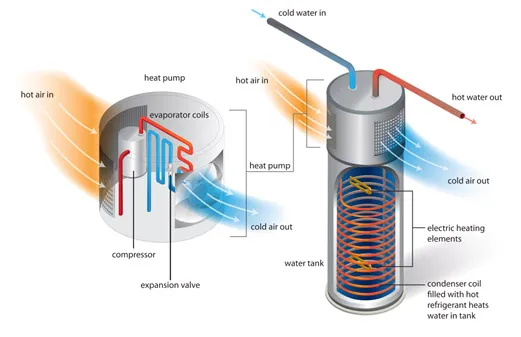
A heat pump water heater can be considered a green and more economical alternative for producing hot water. The term “green” is deserved because this type of heater allows for energy savings (and consequently, lower utility bills) up to 75% compared to traditional water heaters.
In recent years, there has been a growing interest in sustainable living, and heat pump water heaters have become an attractive option for those looking to reduce their carbon footprint. This innovative technology not only saves energy but also reduces greenhouse gas emissions.
Understanding Heat Pump Technology
Before we dive into the specifics of heat pump water heaters, it’s essential to understand how heat pumps work in general. A heat pump is a device that uses refrigeration to transfer heat from one location to another. It works by exploiting the temperature difference between two environments and using that difference to generate heat.
In traditional electric water heaters, electricity is used directly to produce heat. In contrast, heat pump water heaters use the ambient air as a source of energy. This approach reduces the amount of electricity consumed, resulting in lower utility bills and reduced greenhouse gas emissions.
How Does a Heat Pump Water Heater Function?
Heat pump water heaters utilize the same mechanism as heat pumps for heating. By using a heat pump water heater, it’s possible to efficiently heat water up to over 60°C.
Just like observed in the functioning of heat pumps for domestic heating, heat pump water heaters also use a refrigerant fluid that undergoes changes in state (liquid-gas and gas-liquid) and compression-expansion cycles to absorb thermal energy from the air and transfer it to the water, thus warming it up.
The electricity consumed by a heat pump water heater is only what’s necessary for activating the fan to capture the air and operating the compressor responsible for moving the refrigerant fluid in the circuit. Unlike traditional electric water heaters that directly invest energy into producing heat, this type of heater does not consume electricity in a direct manner.
A heat pump water heater’s circuit can be schematized into four components:
- Compressor
- Condenser
- Expansion valve
- Evaporator
The condenser and evaporator are made up of heat exchangers, which do not require electricity to operate: the tubes are in contact with a service fluid (water/air), the so-called refrigerant fluid that loses heat to the condenser while transferring it to the evaporator.
Key Components of a Heat Pump Water Heater
To understand how a heat pump water heater works, let’s take a closer look at its key components:
- Compressor: This component is responsible for compressing the refrigerant fluid and pumping it through the system.
- Condenser: The condenser is a heat exchanger that releases heat from the refrigerant fluid to the surrounding air or water. It’s an essential component of the heat pump system.
- Expansion valve: The expansion valve is responsible for reducing the pressure of the refrigerant fluid, allowing it to expand and become cold.
- Evaporator: The evaporator is a heat exchanger that absorbs heat from the surrounding air or water, causing the refrigerant fluid to expand and become hot.
Measuring Efficiency of Heat Pump Water Heaters
Just like for heat pumps used for domestic heating, efficiency can be measured by the Coefficient of Performance (COP). The COP puts the energy provided (the generated heat) in relation with the energy taken from the electrical grid (electricity consumed).
The Coefficient of Performance varies depending on the type of heat pump and operating conditions (especially based on ambient temperature, since a heat pump becomes ineffective at temperatures between -2°C to 2°C). In standard conditions, the COP for a heat pump water heater is 3:1, meaning that for every single kWh taken from the grid, the heat pump returns 3kWh (2,580 kcal) of heat into the environment it’s heating.
The higher the COP will be, the lower the temperature at which heat is given off (in the condenser), and the higher the temperature of the source fluid (in the evaporator).
Benefits of Heat Pump Water Heaters
Heat pump water heaters offer several benefits over traditional electric water heaters:
- Energy Efficiency: Heat pump water heaters are up to 75% more energy efficient than traditional electric water heaters.
- Lower Utility Bills: By reducing the amount of electricity consumed, heat pump water heaters can lower utility bills and reduce greenhouse gas emissions.
- Increased Hot Water Supply: Heat pump water heaters can provide hot water for longer periods without the need for electricity, making them ideal for households with high hot water demands.
Challenges and Limitations
While heat pump water heaters offer several benefits, there are also some challenges and limitations to consider:
- Higher Upfront Cost: Heat pump water heaters are typically more expensive than traditional electric water heaters.
- Installation Requirements: Heat pump water heaters require specialized installation, which can be challenging for homeowners who lack experience with refrigeration systems.
- Maintenance and Repair: Heat pump water heaters require regular maintenance and repair to ensure optimal performance.
Conclusion
Heat pump water heaters are a green and economical alternative for producing hot water. By understanding how they work, we can appreciate the innovative technology behind them and make informed decisions about our hot water needs. While there are challenges and limitations to consider, the benefits of heat pump water heaters make them an attractive option for households looking to reduce their energy consumption and greenhouse gas emissions.
Frequently Asked Questions
Q: How does a heat pump water heater work?
A: A heat pump water heater works by utilizing the same mechanism as heat pumps for heating. It uses a refrigerant fluid that undergoes changes in state (liquid-gas and gas-liquid) and compression-expansion cycles to absorb thermal energy from the air and transfer it to the water, thus warming it up.
Q: What are the key components of a heat pump water heater?
A: The key components of a heat pump water heater include the compressor, condenser, expansion valve, and evaporator.
Q: How does the Coefficient of Performance (COP) work for a heat pump water heater?
A: The COP measures the energy provided (the generated heat) in relation with the energy taken from the electrical grid (electricity consumed). In standard conditions, the COP for a heat pump water heater is 3:1.
Q: What are some of the benefits of using a heat pump water heater?
A: Some of the benefits of using a heat pump water heater include energy efficiency, lower utility bills, and increased hot water supply.
Q: Are there any challenges or limitations to consider when using a heat pump water heater?
A: Yes, some of the challenges and limitations to consider include higher upfront cost, installation requirements, and maintenance and repair needs.


