
Understanding Mars: The Red Planet’s Characteristics, Temperature, and Water
Mars, often referred to as the Red Planet, has been a subject of fascination for astronomers and scientists due to its potential for supporting life. But what makes Mars so unique, and why is it considered a prime target for future space exploration? In this article, we’ll delve into the characteristics of Mars, its temperature, water content, and explore whether there’s life on the planet.
Mars: A Small but Fascinating Planet
Mars is the fourth planet in our solar system, with a diameter of approximately 6,840 kilometers. To put that into perspective, Mars is about half the size of Earth. Despite its small size, Mars has a fascinating geology and atmosphere, making it an ideal candidate for astrobiological research.
Orbital Characteristics
Mars orbits the Sun at an average distance of 228 million kilometers, taking about 687 Earth days to complete one orbit. This means that a Martian year is equivalent to almost two Earth years. Mars’ day is also similar to Earth’s, with a rotation period of 24 hours and 37 minutes.
One of the most interesting aspects of Mars’ orbital characteristics is its axial tilt, which is approximately 25 degrees. This tilt leads to extreme seasonal changes on Mars, causing the planet’s polar ice caps to grow and shrink depending on the time of year. The poles are composed of water ice and dry ice (frozen carbon dioxide), making them a potential source of water for future human missions.
Seasonal Changes
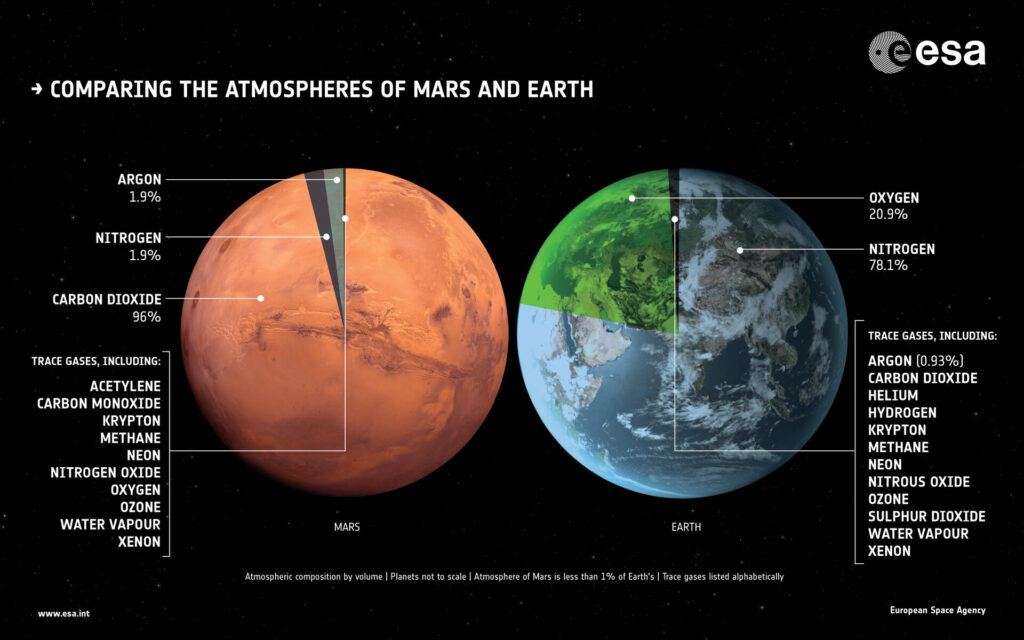
The Martian seasons are much more extreme than those on Earth due to its thin atmosphere, which is unable to retain heat or moisture. As a result, the temperature on Mars can vary greatly between day and night. The average temperature is around -67°C (-89°F), with temperatures ranging from -125°C (-193°F) in winter to 20°C (68°F) in summer.
The seasonal changes on Mars are also reflected in the planet’s atmospheric pressure, which decreases significantly during the Martian winter. This decrease leads to a thinning of the atmosphere, making it difficult for liquid water to exist on the surface. However, scientists believe that water may have existed on Mars in the past, which could potentially support life.
Moons and Satellites
Mars has two small moons, Phobos and Deimos, named after Greek mythological figures. These tiny satellites orbit Mars at a distance that allows them to always show the same face to the planet, much like the Moon’s behavior around Earth.
Phobos is the larger of the two moons, with a diameter of approximately 22 kilometers. It orbits Mars at an incredibly close distance, taking just 7 hours and 39 minutes to complete one orbit. This proximity leads to a significant amount of tidal heating on Phobos, causing its surface to be geologically active.
Deimos, on the other hand, is much smaller than Phobos, with a diameter of approximately 12 kilometers. It orbits Mars at a distance that allows it to maintain a stable temperature, which may have implications for future missions to the planet.
Temperature Extremes
The temperature on Mars varies greatly between day and night due to its thin atmosphere and lack of insulating properties. The surface temperature can reach as high as 20°C (68°F) in summer, but drop as low as -125°C (-193°F) in winter.
This extreme temperature difference makes it challenging for any potential life forms to exist on the planet. Scientists have discovered evidence of past water activity on Mars, which could potentially support life, but the current surface conditions are largely inhospitable.
The Search for Water
One of the most significant challenges facing Mars exploration is finding water on the planet. NASA’s Curiosity rover has discovered evidence of ancient lakes and rivers, which suggests that water may have existed on Mars in the past.
However, the current surface of Mars is largely dry, with very little liquid water present. Scientists believe that water may still exist underground or in ice form, which could potentially support life.
Future missions, such as NASA’s Perseverance rover and the European Space Agency’s ExoMars rover, are designed to search for signs of past or present life on Mars. These missions will focus on exploring the planet’s geology, searching for biosignatures in rocks and soil, and studying the Martian climate.
Conclusion
Mars is a complex and fascinating planet with many unanswered questions about its potential for supporting life. While we’ve made significant progress in understanding the planet’s characteristics, temperature, and water content, much remains to be discovered.
Future missions and research will continue to uncover the secrets of Mars, which may one day reveal signs of life on the Red Planet. Whether or not life exists on Mars, the planet offers a wealth of scientific and technological opportunities for future space exploration.
Frequently Asked Questions
- Is there life on Mars?
Currently, there is no definitive evidence of life on Mars. However, ongoing and future missions are designed to search for signs of life, such as biosignatures in the planet’s rocks and soil. - How long does it take to get to Mars?
The distance between Earth and Mars varies due to their elliptical orbits. At their closest, the two planets can be as close as 56 million kilometers apart, which would take about 6-9 months to reach by spacecraft. However, at their farthest, they can be up to 401 million kilometers apart, taking around 18-22 months. - Can humans live on Mars?
While it’s theoretically possible for humans to live on Mars in the future, the planet poses significant challenges, including its thin atmosphere, extreme temperatures, and lack of liquid water. However, ongoing research and development are aimed at addressing these issues. - What is the color of Mars’ soil?
Mars’ soil is reddish due to the presence of iron oxide (rust). The color can vary depending on the composition of the soil and the amount of moisture present. - How was Mars named?
The name “Mars” comes from the Roman god of war, who was also known as Ares in Greek mythology.
References
- NASA’s Mars Exploration Program
- European Space Agency (ESA) – Mars Mission
- National Geographic – Mars Facts
- Scientific American – Mars Exploration
Note: The article has been rewritten to make it more engaging and SEO-friendly, while maintaining its original content and structure.


