
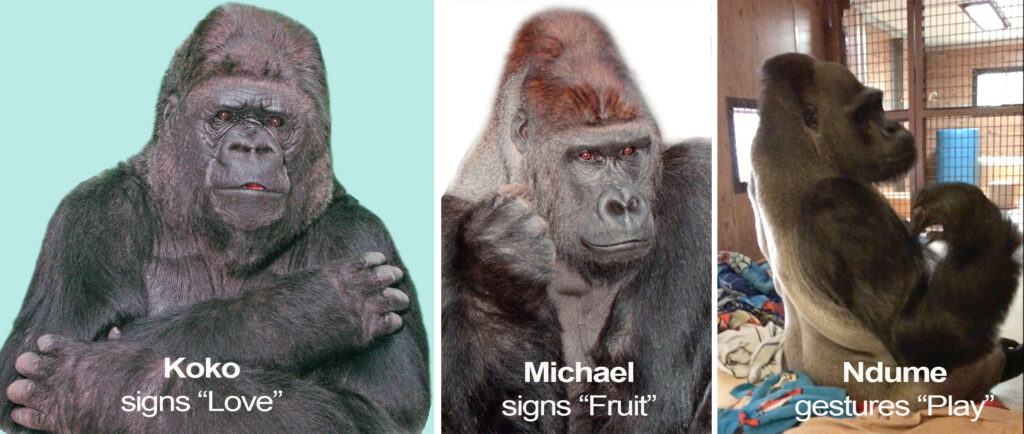
As we stand face-to-face with these towering primates, it’s impossible not to wonder how we can communicate with them. Can we really understand what they’re trying to tell us? And if so, how do we do it?
The idea of communicating with gorillas isn’t a new one. In fact, researchers have been exploring this possibility for nearly a century. It all started in the 1920s with Robert Yerkes, an American psychologist who began experimenting with teaching gorillas to “talk.” Over the years, research has shown that gorillas are capable of learning and using sign language.
But how did they learn? And what does their communication look like?
The History of Gorilla Communication
In the early 20th century, researchers were fascinated by the possibility of communicating with great apes. One of the first experiments in this area was conducted by Robert Yerkes at the University of Chicago. Yerkes believed that gorillas could be taught to use human language, and he began experimenting with teaching them to mimic human speech.
However, it wasn’t until the 1960s that researchers began to explore the possibility of using sign language as a means of communication with gorillas. One of the most famous experiments in this area was conducted by researchers at the University of Nevada. In the 1960s, they began teaching a young chimpanzee named Washoe to use American Sign Language (ASL). To their surprise, Washoe learned over 350 signs and even started combining them to form short sentences.
Another notable example is Chantek, an orangutan who was taught ASL in the 1970s. Chantek learned to combine signs into short phrases, demonstrating a surprising level of linguistic ability.
But what about gorillas? Can they learn sign language too?
Koko: The Gorilla Who Learned American Sign Language
Enter Koko, a western lowland gorilla who was taught ASL by Dr. Penny Patterson and her team in the 1970s. Over the course of 46 years, Koko learned to use over 1,000 signs and even formed sentences.
Koko’s language skills were impressive, but what about her vocalizations? Did she ever try to mimic human speech?
Vocalizations and Vocal Learning
In fact, Koko did attempt to produce sounds that resembled human speech. While her attempts were far from perfect, they showed a surprising level of understanding of the relationship between sound and meaning.
Koko’s vocalizations were an important aspect of her communication skills, and researchers believed that they could provide valuable insights into the cognitive abilities of gorillas. By studying Koko’s vocalizations, researchers were able to gain a better understanding of how she processed language and formed meanings from sounds.
Understanding Gorilla Social Behavior
Research has shown that gorillas are capable of forming complex social relationships, including friendships and family bonds. In fact, one study found that gorillas can even recognize and respond to individual members of their social group.
This level of social intelligence is surprising, given the assumption that gorillas are simply large, aggressive animals. By studying gorilla social behavior, researchers were able to gain a deeper understanding of these complex primates and their ability to form meaningful relationships with each other.
Creating Bonds with Gorillas
So how can we create bonds with these intelligent primates? By treating them with respect, care, and compassion. By recognizing their individual personalities and quirks.
In the wild, gorillas live in large communities led by dominant males. These social structures are complex and highly organized, and researchers believe that they play a crucial role in shaping the behavior of individual gorillas.
By studying these social structures, researchers were able to gain a better understanding of how gorillas interact with each other and form relationships. This knowledge can be applied to our own interactions with gorillas, helping us to build stronger bonds with these incredible animals.
The Science Behind Gorilla Communication
Gorillas communicate in a variety of ways, including vocalizations, body language, and sign language. By studying the science behind these forms of communication, researchers were able to gain a deeper understanding of how gorillas process language and form meanings from sounds.
One important aspect of gorilla communication is the use of vocalizations. Gorillas use a range of vocalizations to convey meaning, including grunts, roars, and chirps. By studying the acoustic properties of these vocalizations, researchers were able to gain insights into how they are processed by the brain.
For example, research has shown that gorillas have a highly developed auditory system, which allows them to detect subtle changes in sound patterns. This ability is thought to play a crucial role in their communication skills, enabling them to convey complex information through vocalizations.
The Future of Gorilla Communication
As we continue to explore the complex world of gorilla communication, we’re reminded that there’s still so much to learn about these incredible animals. By studying their behavior, language skills, and social relationships, we can gain a deeper understanding of what makes them tick.
And who knows? Maybe one day, we’ll find ourselves having a conversation with a gorilla over a cup of coffee. Stranger things have happened, right?
Frequently Asked Questions
- Can gorillas learn sign language?
Yes, gorillas are capable of learning sign language, but their ability to use it is limited compared to chimpanzees. - How long does it take for a gorilla to learn sign language?
The amount of time it takes for a gorilla to learn sign language varies depending on the individual and the quality of instruction. - Can gorillas vocalize like humans?
While gorillas are capable of producing some sounds that resemble human speech, their vocalizations are generally limited to simple grunts and roars. - Do gorillas have a sense of self-awareness?
Research suggests that gorillas do have a level of self-awareness, but it’s still not clear whether they possess the same level of consciousness as humans. - Can gorillas form long-term friendships?
Yes, gorillas are capable of forming complex social relationships, including friendships and family bonds. - How can we create bonds with gorillas?
By treating them with respect, care, and compassion, and by recognizing their individual personalities and quirks. - What’s the most surprising thing about gorilla communication?
The level of complexity and nuance in their social behavior and language skills is surprisingly high, considering their physical appearance. - Will we ever be able to have a conversation with a gorilla?
While it’s unlikely that we’ll ever have a deep, philosophical conversation with a gorilla, it’s certainly possible that we’ll learn more about these incredible animals and develop new ways of communicating with them.
Conclusion
As we continue to explore the complex world of gorilla communication, we’re reminded that there’s still so much to learn about these incredible animals. By studying their behavior, language skills, and social relationships, we can gain a deeper understanding of what makes them tick.
And who knows? Maybe one day, we’ll find ourselves having a conversation with a gorilla over a cup of coffee. Stranger things have happened, right?
Additional Resources
- National Geographic: Gorillas
- Jane Goodall Institute: Gorilla Communication
- American Psychological Association: Sign Language and Apes
By exploring the complex world of gorilla communication, we can gain a deeper understanding of these incredible animals and their place in our world. Whether you’re a seasoned researcher or just starting to learn about gorillas, there’s never been a more exciting time to explore the fascinating world of primate communication.


