
Understanding the Planck Constant: A Fundamental Concept in Physics
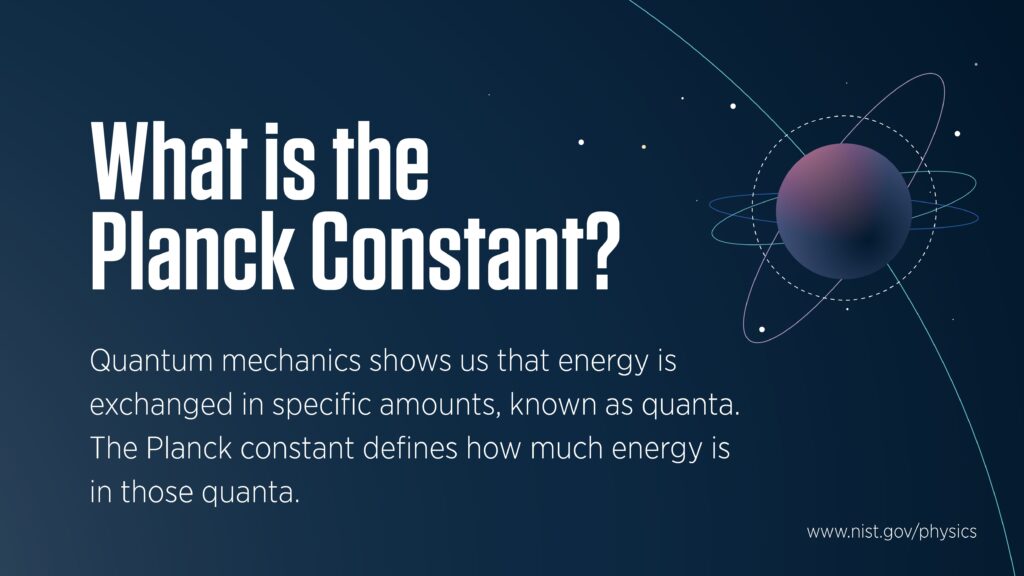
The Planck constant is a tiny letter “h” that can be found in various physics formulas, and it’s deeply connected to the quantization of physical quantities when we study matter at a microscopic level. We’re talking about electrons, protons, neutrons, and photons – all fundamental concepts in physics that also involve the study of electromagnetism and Coulomb’s Law.
What is the Planck Constant?
Despite its seemingly insignificant appearance, the Planck constant plays a crucial role. In general, constants like this one serve as a bridge between different areas of physics. In this case, the Planck constant enables us to quantify physical quantities such as energy, momentum, and angular momentum.
Defining the Planck Constant
Also known as “h,” the Planck constant is named after Max Planck, who introduced it in 1900 while studying the spectrum of blackbody radiation. It’s a fundamental concept in physics, and its discovery marked a significant turning point in our understanding of energy and matter.
The Dimensions of the Planck Constant
As an energy per time, the Planck constant has dimensions that are essential for quantifying energies that are not continuous but rather come in discrete values. This property also plays a crucial role in defining other fundamental constants in physics.
Mathematical Representation of the Planck Constant
The name “Planck” is often accompanied by the Greek letter “P,” specifically “h/2π.” This representation, known as the reduced Planck constant or Dirac’s constant, has a value that complements the original Planck constant.
Quantum Mechanics and Indeterminacy
One of the areas where we find the Planck constant is in the realm of quantum mechanics and the principle of indeterminacy. This principle, first introduced by Werner Heisenberg in 1927, explores the limits of our knowledge when trying to measure the values of coupled variables like energy and time or position and momentum.
Heisenberg’s Uncertainty Principle
In this context, Heisenberg’s uncertainty principle highlights the fundamental limits of measurement in quantum mechanics. This concept has far-reaching implications for our understanding of physical systems and has been extensively experimentally confirmed.
The Discovery of Quantum Mechanics
Around 1900, Max Planck challenged traditional electromagnetism with a groundbreaking hypothesis: that energy was transferred in discrete packets rather than continuously. This innovative idea marked the beginning of quantum mechanics and earned Planck the Nobel Prize in Physics in 1918.
Planck Constant and Fitness: The Plank Exercise
You might be surprised to find the Planck constant mentioned alongside fitness exercises, particularly the plank exercise. In this context, the name “plank” refers to a fundamental movement that targets the muscles of the core, including the abdominal muscles and hip flexors.
Understanding the Connection Between Physics and Fitness
The connection between physics and fitness lies in the way we apply mathematical concepts like the Planck constant to understand the workings of the human body. The plank exercise is an excellent example of this connection, as it requires coordination between multiple muscle groups that are influenced by fundamental physical principles.
Variations on the Plank Exercise
There are several variations of the plank exercise, including the side plank, which targets different muscle groups and offers distinct benefits. By exploring these exercises, we can better appreciate the relevance of physics in our understanding of human physiology.
The Importance of Understanding Physical Constants
In addition to its significance in quantum mechanics and fitness, the Planck constant has far-reaching implications for various fields of study. Its discovery marked a significant turning point in our understanding of energy and matter, paving the way for numerous scientific breakthroughs.
Real-World Applications of Quantum Mechanics
Quantum mechanics is more than just an abstract concept; it has real-world applications that are transforming industries such as technology, medicine, and materials science. From transistors to magnetic resonance imaging (MRI), quantum mechanics plays a crucial role in shaping our modern world.
The Future of Physics: Exploring the Mysteries of the Universe
As we continue to explore the mysteries of the universe, the Planck constant remains an essential tool for physicists and researchers. Its continued study will help us better understand the fundamental laws that govern our cosmos and unlock new avenues for scientific discovery.
Quantum Computing and the Power of Information
The development of quantum computing has sparked a new era of innovation and exploration in the field of physics. By harnessing the power of quantum mechanics, researchers are working to create faster, more efficient computers that can solve complex problems beyond the capabilities of classical computers.
Conclusion: The Planck Constant in Perspective
In conclusion, the Planck constant is a fundamental concept in physics that has far-reaching implications for our understanding of energy, matter, and the universe as a whole. Its connection to fitness exercises like the plank provides a unique perspective on the relevance of physics in everyday life.
As we continue to explore the mysteries of the universe, the Planck constant remains an essential tool for physicists and researchers. Its continued study will help us better understand the fundamental laws that govern our cosmos and unlock new avenues for scientific discovery.
Frequently Asked Questions
Q: What is the Planck constant?
A: The Planck constant is a fundamental concept in physics that enables us to quantify physical quantities like energy, momentum, and angular momentum.
Q: Who discovered the Planck constant?
A: Max Planck introduced the Planck constant in 1900 while studying blackbody radiation.
Q: What are the dimensions of the Planck constant?
A: As an energy per time, the Planck constant has dimensions that enable us to quantify energies that come in discrete values.
Q: How does the principle of indeterminacy relate to the Planck constant?
A: The principle of indeterminacy, introduced by Werner Heisenberg, explores the limits of our knowledge when trying to measure coupled variables like energy and time or position and momentum.
Q: What is the significance of the Planck constant in fitness?
A: The plank exercise, also known as “plank,” targets specific muscle groups that are influenced by fundamental physical principles, illustrating the connection between physics and fitness.
Q: How can I incorporate the planck constant into my daily life?
A: While you may not directly apply the Planck constant to your daily routine, understanding its significance in physics and fitness can help you appreciate the intricate workings of the human body.
Q: What are some applications of quantum mechanics beyond the Planck constant?
A: Quantum mechanics has far-reaching implications for our understanding of physical systems, from the behavior of subatomic particles to the properties of materials at the nanoscale.


