
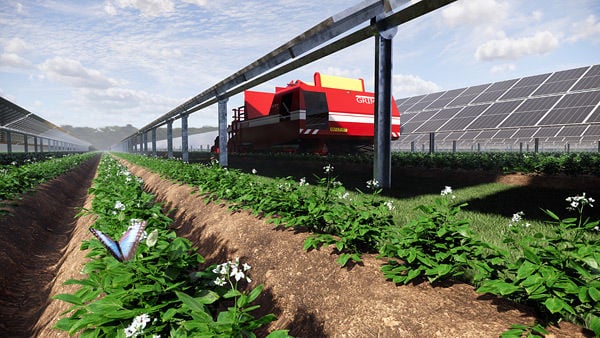
As the world shifts towards renewable energy sources, agricultural photovoltaics (PV) has emerged as a promising field. However, navigating the tax implications can be complex, especially for farmers who want to harness the power of solar energy on their land. In this article, we will delve into the world of agricultural PV and taxation, exploring the rules and regulations that govern this sector.
Understanding the Agenzia delle Entrate’s Stance
The Agenzia delle Entrate (Italian Tax Agency) has issued a resolution (n. 86/E) on October 15, 2015, clarifying its stance on agricultural PV and taxation. According to this resolution, agricultural PV is considered an activity conjoined with farming, making it eligible for specific tax benefits.
Calculating Taxation on Agricultural Photovoltaics
One of the primary concerns for farmers installing PV systems near their land is determining how to calculate taxes on the energy produced. The Agenzia delle Entrate states that taxation depends on the power of the system and its connection to agricultural activities.
To illustrate, let’s consider an example:
- Suppose a farmer installs a 100 kW PV system on his land.
- If the system is connected to the farm’s main building or other structures, it may be considered as part of the farm’s overall energy production.
- However, if the system is installed separately from the main building and produces excess energy beyond its capacity (e.g., 100 kW), the farmer will need to calculate taxes based on this excess energy.
Credito Catastale: A Potential Solution
The Agenzia delle Entrate also mentions the possibility of using the Credito Catastale, which allows farmers to determine their taxable income at a rate of 25% compared to their agricultural revenues. This can be an attractive option for farmers who want to take advantage of tax benefits.
Società Agricola: A Key Player in Agricultural PV
The resolution highlights that certain types of companies (società agricole) may opt for taxation on a catastrophic basis. These companies must have the word “agricultural company” in their name or registration documents and must exclusively carry out farming activities.
Producing Energy from Agricultural Photovoltaics: An Activity Conjoined
Agricultural PV is defined as an activity conjoined atypical, meaning it doesn’t require agricultural products. The only connection required is that the land on which the PV system is installed belongs to the farmer or is used by their business.
For instance:
- A farmer installs a 10 kW PV system on his land and uses the electricity to power his farm.
- In this case, the energy produced from the PV system can be considered part of the farm’s overall energy production.
Ministerial Guidance: The First 200 kW Threshold
The Minister for Agricultural Policies and Forestry has clarified that agricultural PV systems with a capacity of up to 200 kW are always considered conjoined activities.
However, if the total installed capacity exceeds this threshold:
- Only part of the excess capacity (beyond 200 kW) may be considered an activity conjoined.
- The farmer must demonstrate ownership or use of at least one hectare of land for agricultural purposes.
Taxation on Agricultural Photovoltaics Beyond the Initial Threshold
If the PV system’s total installed capacity exceeds 1 MW, only part of it can be considered a conjoined activity. In this scenario:
- To qualify as a conjoined activity, the farmer must demonstrate ownership or use of at least one hectare of land for agricultural purposes.
- The energy produced from the excess capacity beyond the initial threshold (200 kW) is subject to normal tax calculation rules.
Case Studies and Examples
To better understand the application of these rules, let’s consider a few case studies:
- A farmer installs a 500 kW PV system on his land, which produces excess energy beyond its capacity.
- Another farmer installs a 10 kW PV system that is connected to the farm’s main building.
Conclusion and Frequently Asked Questions
The world of agricultural PV and taxation can be complex, but understanding these rules can help farmers unlock the potential of solar energy on their land. Here are some frequently asked questions that summarize key points:
- What is agricultural PV?
- Agricultural photovoltaics refers to the production of electricity from solar panels installed on agricultural land.
- How do I calculate taxes on my agricultural PV system?
- The tax calculation depends on the power of the system and its connection to agricultural activities.
- Can I claim Credito Catastale for my agricultural PV system?
- Yes, but only if your company is registered as a società agricola and you meet specific requirements.
Final Thoughts
The rules governing agricultural PV and taxation in Italy are subject to change. To ensure compliance with the latest regulations, farmers should consult with qualified tax professionals or seek guidance from relevant government agencies. By understanding these rules, farmers can harness the potential of solar energy on their land while minimizing their tax burden.
Additionally, consider the following recommendations:
- Regularly review and update your tax strategy to stay in line with changing regulations.
- Consider consulting with a tax professional who specializes in agricultural PV taxation.
- Keep accurate records of your agricultural activities, including land use and energy production.


