
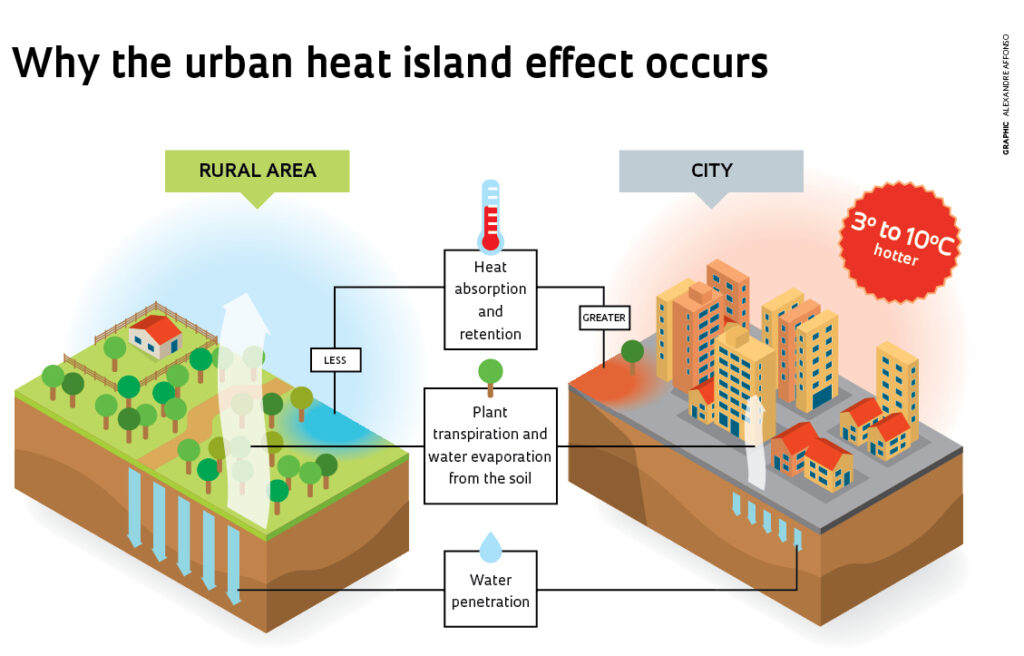
Are you living in a concrete jungle in the middle of a bustling city? You’ve probably heard about the concept of the urban heat island. Cities are hotter than the rest of the land, so if you live in the heart of the city, be prepared for your mercury column to show a few extra degrees compared to the suburbs.
The phenomenon of the urban heat island has several negative impacts on human health, which can be directly and indirectly reflected in various ways:
- Increased energy consumption to cool down indoor spaces (air conditioners, climate control systems, ventilation…)
- Consequent high emission of pollutants and greenhouse gases, including ozone
- Transported pollutants from urban drainage waters and consequent increase in water surface temperatures
What causes the urban heat island?
The causes are two and intensify each other:
- In cities, solar radiation is absorbed more due to materials like asphalt and cement that accumulate heat.
- The use of energy-consuming devices: cars, household appliances, air conditioners… everything that consumes energy releases heat. If a conditioner cools your house, the external unit releases heat that increases the urban heat island phenomenon.
Urbanization has been a long process in history, with cities expanding over time due to population growth and urbanization policies. The development of industrialization has been another key factor in the increase in city sizes. The construction of skyscrapers is also an important aspect of this expansion, which adds to the overall urban heat island problem.
The urban heat island is only one consequence of human urbanization and cementation: other dramatic repercussions are felt with the problem of severe flooding. Heavy rainfall can cause a rapid increase in water levels, leading to flash floods that can be deadly. This happens because rainwater cannot penetrate the pavement quickly enough due to its high thermal conductivity.
Breaking through cementation requires contributions to promote the reuse of already degraded zones: how many abandoned warehouses have you noticed in your city? In this context, fiscal incentives for soil reuse were launched. Environmental problems rarely have immediate solutions. To reduce the urban heat island phenomenon in some cities, researchers are looking for alternative materials to asphalt. Asphalt has a dark color and a low reflectivity coefficient, which means it absorbs heat. A NASA test is using white roofs to counteract the urban heat island; white is a reflective color.
Green rooftops and vegetal walls could be even more effective:
Lighter asphalt versions have been developed for roads, which are less inclined to absorb heat and reflect light better, making streets safer too. The bioasphalt, made with organic nano-materials, has a lower environmental impact but its high production costs make it prohibitively expensive.
To give you an idea of the disparity between green space and asphalt, think that one square meter of asphalt absorbs 6 times more heat than the same surface of grass. If you’re interested in fighting the urban heat island (a problem felt especially in cities like Bologna, Milan, Trento, Ancona, Torino…), start a movement to promote the installation of green roofs and increase urban green spaces.
If you want to begin from your home, here’s a guide on how to create a green roof. You could also propose to your local administration to use smart urban furniture like Tillandsia plants.
Feel free to follow me on Twitter, add me to Facebook, join my Google+ circle or see my photos on Instagram – the social media options are endless!
You might find this article on “The Hole in the Ozone”


