
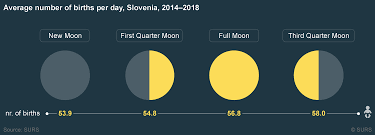
Is there a connection between the full moon and childbirth? Many experts have wondered whether the lunar cycle can influence pregnancy. Let’s explore if it’s just a myth or if there’s some basis for this claim.
Can the Full Moon Affect Childbirth?
Scientific studies provide an unequivocal “no” to this question, but many of them are inconclusive due to the lack of data and evidence. Since we’re composed of 80% water, why can’t the moon influence our bodies? This is the central question.
Throughout history, populations have believed that the full moon could be responsible for various phenomena. Ancient beliefs associate the lunar cycle with female fertility. However, these are mere myths with no concrete evidence in the academic world.
The Connection Between Meteorology and Childbirth
Some people suggest that atmospheric pressure, rather than the full moon, may affect childbirth. A 2007 study published in Archives of Gynecology and Obstetrics found a relationship between birth rates and atmospheric pressure. However, this pressure is not influenced by the full moon but by weather events like storms.
According to the American Meteorological Society Glossary, atmospheric pressure is defined as “the force exerted by the atmosphere on a given point.” Some researchers have even hypothesized that severe weather events, such as hurricanes and tornadoes, can induce labor due to their effect on pressure. Let’s focus on our moon again. Is there any connection between the full moon and childbirth?
The Moon’s Attraction: A Theoretical Perspective
Just like the moon affects tides, it could potentially influence the human body. Theoretically, the moon’s gravitational pull might affect women who are close to their due date or experiencing contractions.
Despite this theoretical framework, there is no scientific evidence that supports the claim that the full moon causes more births. Many obstetricians and medical professionals assert that nights with a full moon are associated with an increase in deliveries. According to them, if the amniotic sac is under pressure, it can induce labor and trigger contractions.
Even the staff at Sacramento’s Hospital reported a surge of 45 babies born within 48 hours during a full moon! While these anecdotes might seem convincing, one study conducted by astronomer Daniel Caton in 2001 analyzed data from 20 years (National Center for Health Statistics) and found no correlation between the full moon and childbirth.
The Cultural Significance of Lunar Cycles
Even when faced with scientific evidence, we continue to believe that the full moon can influence pregnancy and childbirth due to our cultural baggage!
Our beliefs about lunar cycles are deeply ingrained in us. Like old myths, they refuse to die out! The connection between lunar cycles and female fertility is rooted in folklore and has been passed down through generations.
While it’s true that some medical professionals perpetuate these myths, the full moon becomes an arbitrary reference point for both pregnant women and those hoping to become mothers!
Fortunately, this myth about the full moon causing labor is harmless. However, there are other beliefs that are far from innocuous!
Can You Do a Home Pregnancy Test?
If you’re wondering when to take a home pregnancy test, we’ll explore that in another article.
In summary, while there’s no concrete evidence linking the full moon to childbirth, our cultural background and old myths keep us connected to this belief. The good news is that these myths are completely harmless, but it’s essential to separate fact from fiction when discussing pregnancy and childbirth.
Frequently Asked Questions
-
Does the Full Moon Cause Labor?
There is no scientific evidence supporting the claim that the full moon causes more births or induces labor. -
How Does Atmospheric Pressure Affect Childbirth?
Research shows a correlation between birth rates and atmospheric pressure but attributes it to weather events, not the lunar cycle. -
What’s the Scientific Explanation for Lunar Cycles and Fertility?
There is no concrete scientific evidence linking lunar cycles with female fertility or childbirth. -
Can You Trust Medical Professionals on This Matter?
While some medical professionals support the idea that full moons can influence pregnancy, there is no conclusive evidence to back this claim up. -
What Are Some Harmless Beliefs About Lunar Cycles and Pregnancy?
Old myths about lunar cycles causing female fertility are harmless but continue to influence our cultural background. -
Can Lunar Cycles Affect Human Behavior?
There’s limited research on the impact of lunar cycles on human behavior, but most studies show no significant correlation. -
What Should I Do If I’m Experiencing Contractions During a Full Moon?
Consult with your healthcare provider if you’re experiencing contractions; they’ll help determine the cause and provide guidance. -
How Can I Separate Fact from Fiction on Lunar Cycles and Pregnancy?
Be cautious of myths and anecdotes; rely on scientific evidence to form an informed opinion about lunar cycles and pregnancy.
The Myth of Lunar Cycles in Folklore
Lunar cycles have been a part of human folklore for centuries, influencing various aspects of our lives. From ancient agricultural practices to modern-day astrology, the moon’s phases continue to hold significant cultural importance.
In many cultures, the full moon is associated with fertility and abundance. In ancient Greece, the full moon was seen as an opportunity for new beginnings and fertility rituals were performed during this time.
Similarly, in some African cultures, the full moon is believed to be a sacred moment when women’s bodies are at their most receptive to conception. These beliefs highlight the deep connection between lunar cycles and human reproduction.
However, despite these cultural associations, there is no scientific evidence to support the claim that the full moon can influence fertility or childbirth.
The Moon and Human Behavior: A Limited Understanding
Lunar cycles have been observed to affect various aspects of human behavior, from increased risk-taking to heightened emotional sensitivity. However, the scientific understanding of this phenomenon is still limited.
Research suggests that lunar cycles may impact our emotions, energy levels, and even sleep patterns. However, these effects are often short-term and not directly linked to fertility or childbirth.
In conclusion, while the full moon remains an enigmatic force in human culture, there is no concrete evidence linking it to childbirth or fertility. It’s essential to separate fact from fiction when discussing lunar cycles and pregnancy, acknowledging both the cultural significance of lunar cycles and the lack of scientific evidence supporting their influence on our bodies.
Breaking Down the Lunar Cycle Myth
In order to break down the myth of lunar cycles influencing pregnancy, we must examine the available evidence critically. Here are some key points to consider:
- Lack of Scientific Evidence: Despite extensive research, there is no conclusive evidence linking the full moon to childbirth or fertility.
- Cultural Significance: Lunar cycles have been deeply ingrained in human culture for centuries, influencing various aspects of our lives.
- Theoretical Frameworks: Theoretically, the moon’s gravitational pull could potentially influence women close to their due date or experiencing contractions. However, this framework has not been proven scientifically.
- Atmospheric Pressure: Research suggests that atmospheric pressure may affect childbirth, but this is attributed to weather events rather than lunar cycles.
Conclusion
The connection between the full moon and childbirth remains a topic of debate. While some experts argue that lunar cycles can influence fertility, there is no concrete evidence to support this claim. By separating fact from fiction and acknowledging both the cultural significance of lunar cycles and the lack of scientific evidence, we can break down the myth surrounding lunar cycles and pregnancy.
Resources
- National Center for Health Statistics (NCHS)
- Archives of Gynecology and Obstetrics
- American Meteorological Society Glossary
- Daniel Caton’s study on lunar cycles and childbirth (2001)
Remember, while the full moon may hold cultural significance, it is not a reliable indicator of fertility or childbirth. If you’re expecting a baby, consult with your healthcare provider for accurate information and guidance.


