
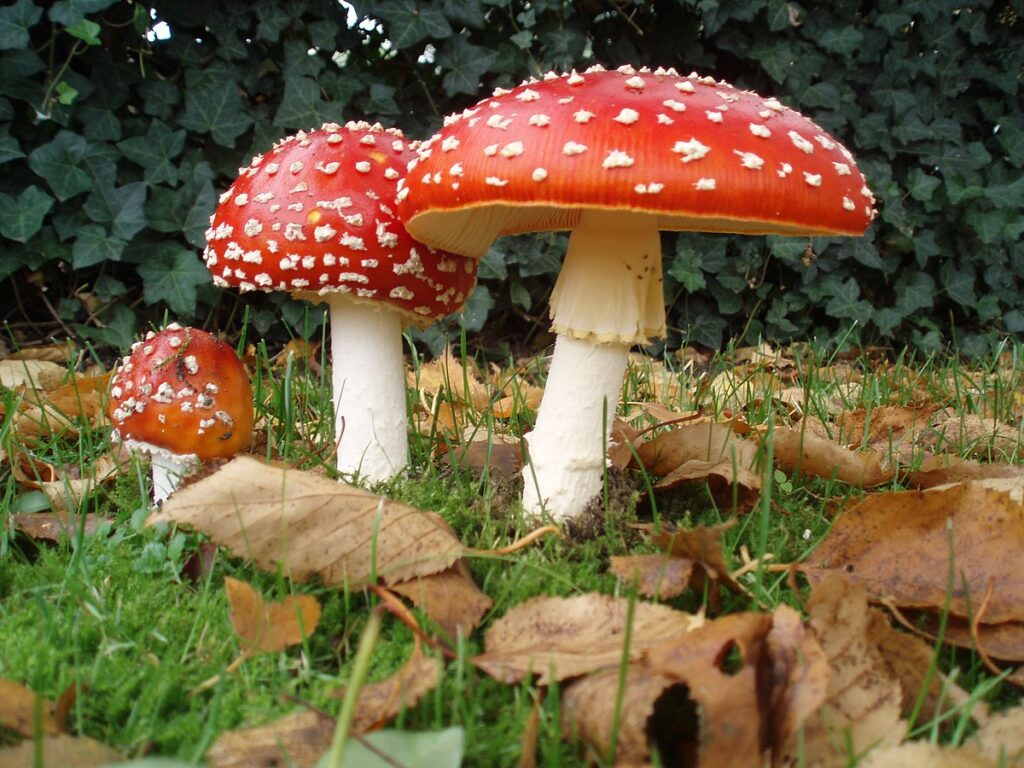
The Amanita Muscaria, also known as the “poisonous mushroom” or “devil’s truffle,” is a highly toxic fungus that has been shrouded in mystery and intrigue for centuries. Despite its toxicity, some populations in Arctic regions still use it in their traditional ceremonies. In this article, we will delve into the characteristics, habitat, and curiosities surrounding this enigmatic mushroom.
Contents
- Description of the Amanita Muscaria
- Habitat of the Fungus
- Morphological Characteristics of the Amanita Muscaria
Description of the Amanita Muscaria
The Amanita Muscaria can be found in various sizes, with a cap diameter ranging from 7 to 25 cm. The young specimens are ovoid-shaped and covered in a white gill that resembles an eggshell, giving it a distinctive appearance. As it matures, the cap becomes convex and then flat, displaying a range of colors from deep red to reddish-orange. The stems are white or whitish-yellow and feature an annulus (ring) at the base.
Habitat of the Fungus
The Amanita Muscaria thrives in shady areas with well-drained soil, often growing under conifers like red pine and birch trees or among shrubs. It can be found throughout Europe during the summer months, typically from late August to November.
Morphological Characteristics of the Amanita Muscaria
The Amanita Muscaria belongs to the genus Amanita, which may have originated from the ancient Greek word “amanitai,” referring to fungi in general. The name “Muscaria” is derived from the fact that its cuticle appears to repel mosquitoes.
Cappello (Cap)
The cap or fruiting body of the Amanita Muscaria can grow up to 25 cm in diameter and has a shiny, viscid surface. Its color ranges from deep red to reddish-orange, with white or whitish-yellow scales that eventually fall off as it matures.
Imenoforo (Gills)
The imenophore is composed of thin, free gills that are tightly packed, sometimes interspersed with small, gill-like structures called lamellules. The gills are large and wavy, measuring up to 1 cm in width.
Gambo (Stem)
The stem or stalk of the Amanita Muscaria is white and cylindrical, tapering towards its base. It has a ring-like structure at the top, called an annulus, which remains attached even after the cap has opened. The volva (membrane) still covers the bulbous base of the stem.
Anello
The annulus or ring at the top of the stem is white and striated, with remnants of the volva membrane still clinging to it.
Carne (Mushroom Flesh)
The flesh of the mushroom can be quite dense in its cap and fibrous in its stem. The color varies from white to orange-red, with a lack of odor and a mild, sweetish taste.
Tossicità dell’Amanita Muscaria
Despite its potential allure, the Amanita Muscaria is highly toxic due to the presence of muscarine (C9H20NO2), a potent toxin that affects the autonomic nervous system. The effects of muscarine can mimic those of acetylcholine, causing various symptoms such as flushing, hallucinations, and convulsions.
Curiosità sull’Amanita Muscaria
The Amanita Muscaria has been used in traditional ceremonies for centuries due to its psychoactive properties. In Arctic regions, it is still used today by indigenous communities. In ancient cultures, the mushroom was considered a sacred substance and played a role in shamanic rituals.
Historical Use of the Amanita Muscaria
The use of the Amanita Muscaria dates back to prehistoric times. Archaeologists have found evidence of its use in ancient cultures, including cave paintings and artifacts. The mushroom was considered a powerful symbol of fertility and spirituality.
Ancient Greek and Roman Traditions
In ancient Greece, the Amanita Muscaria was associated with the god Dionysus, who was revered as the patron deity of wine, fertility, and ecstasy. The mushroom was also used in rituals to induce a state of trance or spiritual ecstasy.
Native American Use of the Mushroom
In North America, the Amanita Muscaria was used by some Native American tribes for its psychoactive properties. However, it is worth noting that its use was not widespread and was often limited to specific cultural practices.
Alaska and Canada Traditions
In Alaska and Canada, the mushroom was considered a sacred substance and played a role in shamanic rituals. The indigenous communities used it to communicate with spirits and ancestors.
Modern Use of the Amanita Muscaria
Today, the Amanita Muscaria is still used in traditional ceremonies by some indigenous communities. However, its use is not widespread and is often limited to specific cultural practices.
Psychedelic Research
Some researchers have studied the effects of the Amanita Muscaria on human subjects, hoping to understand its potential therapeutic applications. However, more research is needed to fully understand the mushroom’s properties and safety profile.
Conclusion
The Amanita Muscaria is a highly toxic fungus that has been shrouded in mystery and intrigue for centuries. Despite its toxicity, it has been used in traditional ceremonies for centuries due to its psychoactive properties. Its use is not widespread today, but it continues to fascinate researchers and enthusiasts alike.
FAQs
- Q: Is the Amanita Muscaria safe to eat?
A: No, due to its toxicity, it’s not recommended to consume this mushroom. - Q: Can I grow an Amanita Muscaria at home?
A: No, it is a wild mushroom that requires specific environmental conditions and cannot be cultivated indoors. -
Q: What are the effects of muscarine on humans?
A: Muscarine can cause hallucinations, convulsions, and other symptoms due to its toxic effects on the autonomic nervous system. -
Q: Can I use Amanita Muscaria for medicinal purposes?
A: No, it is not recommended to consume this mushroom due to its toxicity. -
Q: Is the Amanita Muscaria still used in modern medicine?
A: There is no scientific evidence supporting the use of Amanita Muscaria in traditional medicine. -
Q: Can I find Amanita Muscaria in my backyard?
A: While possible, it’s not recommended to search for this mushroom at home due to its toxicity and potential harm. -
Q: How can I distinguish between edible and poisonous mushrooms?
A: Consult with a qualified expert or take online courses on mushroom identification. -
Q: Can Amanita Muscaria be used as a natural remedy for mental health issues?
A: There is no scientific evidence supporting the use of this mushroom as a treatment for mental health conditions, and it can be harmful if ingested in large quantities.


