
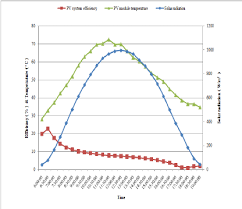
As we all know, overheating of solar panels can lead to poor performance, resulting in a significant decrease in electricity production. This introduction serves as a starting point for exploring the concept of NOCT (Nominal Operating Cell Temperature) and its significance.
What is NOCT?
NOCT stands for Nominal Operating Cell Temperature, referring to the nominal working temperature of a solar cell within a module under specific environmental conditions: 800 W/m2 irradiance, a 20°C ambient temperature, and a wind speed of 1 m/s. This definition provides a foundation for understanding the concept of NOCT.
Understanding NOCT in Photovoltaic Systems
NOCT refers to an photovoltaic system installed on a frame with particular environmental conditions that allows sunlight to hit the surface normally as indicated by the CEI EN 60904-3 guidelines.
The NOCT temperature, or the nominal working temperature of the solar cell, is a parameter provided by the manufacturer, typically ranging between 40°C and 50°C, but potentially up to 60°C in cases with high-efficiency photovoltaic modules with glass covers.
Optimal Temperature for Solar Panel Performance
For optimal performance, the ideal temperature range is around 25°C. As temperatures rise above this level, the solar panel’s efficiency can decrease due to overheating, which affects the system as a whole.
Studies indicate that classic silicon-based photovoltaic cells used in modules may experience an approximately 0.5% loss of efficiency for every degree Celsius above ambient temperature.
In simpler terms, all solar panels lose efficiency when exposed to higher temperatures. This is why it’s crucial to carefully examine the technical specifications provided by the manufacturer and calculate the coefficient of temperature to determine the potential loss of efficiency with each degree above ambient temperature.
Temperature-Related Losses in Photovoltaic Systems
Temperature-related losses are a critical factor in understanding the performance of solar panels. These losses can be categorized into two main types: thermal losses and electrical losses.
Thermal losses occur when the temperature increases, causing the semiconductor material to expand and lose its ability to conduct heat efficiently. This leads to a decrease in the solar panel’s efficiency.
Electrical losses, on the other hand, are related to the internal resistance of the solar panel, which can also increase with rising temperatures. These electrical losses can be even more significant than thermal losses, as they affect the overall system performance.
Temperature Coefficient in Photovoltaic Modules
The coefficient of temperature (TC) measures how much a solar module loses efficiency for every degree Celsius increase in temperature. A lower TC value indicates better performance under varying temperatures.
For older generations of photovoltaic modules, the TC is approximately 0.50%. This means that for each degree above ambient temperature, there’s a corresponding loss of around 0.50% in efficiency per module. In contrast, newer systems can exhibit TC values as low as 0.25% per degree Celsius.
NOCT and Its Relevance to Photovoltaic Systems
The concept of NOCT helps us understand why solar panels installed in Germany might have the same performance as a photovoltaic solar panel located near the equator. This is due to the cells’ ability to maintain efficiency despite extreme temperatures, which would otherwise cause significant losses.
The intense sunlight at the equator compensates for the excessive heat that can damage photovoltaic modules, resulting in similar performance levels between these two locations, despite their vastly different geographical exposures.
Troubleshooting Photovoltaic Systems with Temperature Issues
If you suspect your solar panel system has experienced a decline in energy production and assume the presence of hot spots (overheated cells or damaged modules due to high temperatures), using thermography can help identify these issues.
In the accompanying photo, simultaneous inspection of multiple photovoltaic panels reveals an overheated spot using Fluke thermal cameras.
Thermography is a non-destructive testing method that allows for the detection of temperature anomalies within the panel. This technique helps to diagnose and address potential problems before they cause further damage to the system.
Preventing Temperature-Related Losses in Photovoltaic Systems
To prevent temperature-related losses, it’s essential to design and optimize your photovoltaic system correctly. Here are some strategies to consider:
- Choose the right solar panel for your location: Selecting a solar panel with a lower TC value can help mitigate potential losses due to overheating.
- Optimize system design: Ensure that your solar panel system is designed to withstand extreme temperatures and provides adequate shading to reduce heat gain.
- Monitor temperature regularly: Regularly check the temperature of your solar panels to identify any hot spots or overheated cells.
- Use cooling systems: Consider installing a cooling system, such as air conditioning units or misting systems, to keep your solar panels at an optimal temperature.
Conclusion
By understanding NOCT and its significance in photovoltaic systems, we can optimize performance and ensure that our solar panels operate efficiently. By recognizing temperature-related losses and choosing modules with lower TC values, we can maximize the output of our solar panel systems.
Frequently Asked Questions
- What is the ideal temperature for optimal solar panel performance?
Answer: The ideal temperature range for optimal solar panel performance is around 25°C. - How much does a 1°C increase in temperature affect solar panel efficiency?
Answer: A 1°C increase can result in approximately 0.5% loss of efficiency, depending on the module’s coefficient of temperature (TC). - What is the coefficient of temperature (TC) and its significance?
Answer: The TC measures how much a solar module loses efficiency for every degree Celsius increase in temperature. - How do I identify hot spots or overheated cells in my photovoltaic system?
Answer: Using thermography, such as Fluke thermal cameras, can help detect overheated areas within the panel. - What are the benefits of choosing a photovoltaic module with a lower coefficient of temperature (TC)?
Answer: Choosing modules with lower TC values can optimize performance under varying temperatures and reduce potential losses due to overheating. - Can I still achieve optimal solar panel performance in cold climates?
Answer: While it may be more challenging, optimizing system design and choosing the right module for your location can help mitigate temperature-related losses. - How do environmental factors like wind speed affect solar panel performance?
Answer: Wind speeds between 1 m/s and 5 m/s are typically considered optimal for photovoltaic systems, as higher speeds can reduce efficiency while lower speeds may increase energy production. - Can I still maintain my photovoltaic system’s performance if it experiences hot spots or overheating issues?
Answer: Yes, identifying and addressing hot spots or overheated cells promptly is essential to prevent further damage and maintain optimal system performance.


