
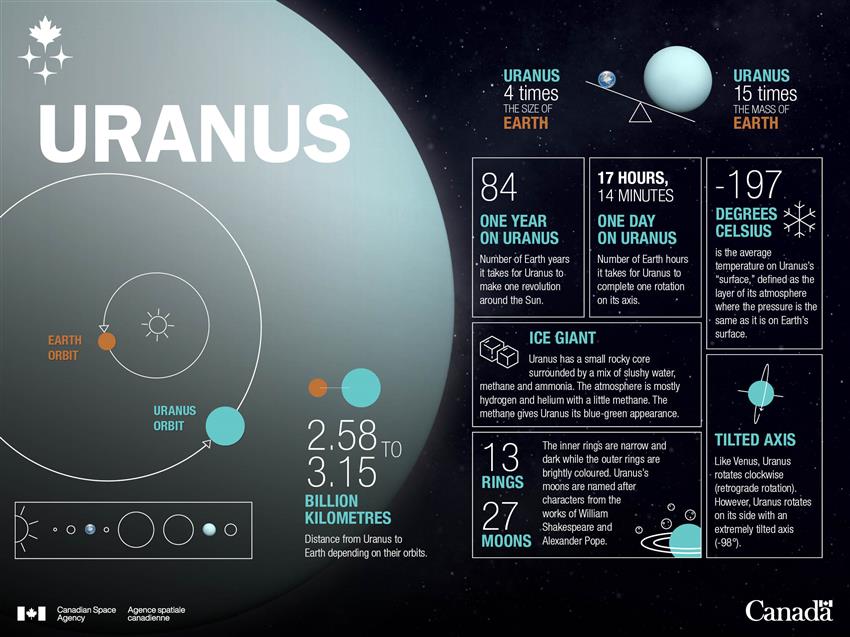
As we explore the vast expanse of our solar system, there’s one planet that often gets overlooked – Uranus. While Venus, Mars, and Saturn are commonly mentioned, Uranus boasts unique characteristics that warrant closer examination. With no known inhabitants, but an abundance of gases, let’s embark on a journey to discover this distant world.
Characteristics of Uranus
One of the first notable features of Uranus is its gaseous composition. It shares similarities with Jupiter and Saturn, often referred to as the “sister planets” due to their analogous characteristics. A comparison can also be drawn between Uranus and Neptune, both icy giants in the outer reaches of our solar system.
However, it’s essential to note that Uranus was discovered relatively recently, in 1781 by William Herschel. Due to its vast distance from Earth, it requires advanced equipment to observe, making it difficult to spot without assistance. Thankfully, we now have better tools to describe and study this planet.
Uranus presents a unique appearance, often described as “smooth” with no distinct structures, featuring a green-blue coloration. Its physical and chemical properties have been extensively studied, revealing that the planet’s gravity is insufficient to retain lighter gases such as hydrogen and helium. As a result, Uranus’ atmosphere consists mainly of heavier gases like water vapor, ammonia, and methane, responsible for its distinctive blue-green hue.
In comparison to other gas giants, Uranus appears relatively small, yet it possesses a mass 14 times that of Earth. To put this into perspective, Uranus could contain over 60 planets like our own Earth, showcasing its immense size and complexity.
The Unusual Rotation Period
Uranus’ rotation period is quite unique, lasting approximately 17 hours and 14 minutes on the planet’s axis. However, what sets it apart from other planets is that it rotates on its side, with an inclination of 98 degrees relative to its orbit. This unusual orientation causes extreme variations in temperature between the poles and equator.
The polar regions receive significantly more sunlight and heat due to their tilted position, while the equatorial region experiences much less. Interestingly, this phenomenon is not observed on Earth or other planets, where the tilt is relatively minor.
Temperature: A Chilly World
Uranus’ atmosphere is incredibly cold, with temperatures reaching as low as -200°C. The planet’s distance from the Sun, approximately 19 times that of Earth, contributes to its frigid environment.
The composition of Uranus’ internal structure has also been studied extensively. At its core lies a rocky nucleus surrounded by ice, while the outer atmosphere consists of dark, dusty material in 11 distinct rings. These rings were first observed in detail during the Voyager 2 mission in 1986, which revealed the presence of 15 known moons.
The Moons of Uranus
Each of these moons is named after characters from Shakespeare and Pope’s works, adding a touch of poetic flair to this celestial body. While the exact number of satellites may be higher than initially believed, Titania, Oberon, Umbriel, Ariel, and Miranda are among the largest.
- Titania: With a diameter of approximately 1,578 kilometers (981 miles), Titania is the largest moon of Uranus.
- Oberon: This moon has a diameter of around 1,523 kilometers (946 miles) and is also one of the most distant satellites from Uranus.
- Umbriel: Named after John Milton’s epic poem “Paradise Lost,” Umbriel measures approximately 1,166 kilometers (726 miles) in diameter.
- Ariel: With a diameter of about 1,159 kilometers (721 miles), Ariel is one of the most prominent moons in Uranus’ system.
- Miranda: This moon has a diameter of around 479 kilometers (304 miles) and is known for its unique geology and atmospheric features.
The Astrological Significance of Uranus
In astrology, Uranus is often associated with unconventional thinking, innovation, change, technology, and scientific inquiry. Individuals born under this sign tend to possess an inquiring nature, a tendency towards nonconformity, and a willingness to challenge established norms.
Uranus is also linked to advancements in technology and scientific inquiry, particularly in fields like architecture, engineering, politics, and art. Its presence can indicate a strong connection to the unknown, a sense of restlessness, and an innate curiosity about the world around us.
Theoretical Models and Hypotheses
Scientists have proposed various theories to explain Uranus’ unique characteristics. Some of these include:
- Planetary formation theory: One hypothesis suggests that Uranus formed through the capture of nearby icy bodies or the gravitational disruption of a larger object.
- Giant impact hypothesis: Another theory proposes that Uranus was affected by a massive collision with another planet, resulting in its altered rotation and magnetic field.
- Solar nebula hypothesis: This model suggests that Uranus formed from the solar nebula, a cloud of gas and dust that surrounded our Sun after its formation.
While these theories provide valuable insights into Uranus’ development, much remains to be discovered about this enigmatic planet. Further research and exploration are necessary to uncover more secrets about Uranus and its place within our solar system.
Conclusion
As we delve into the mysteries of Uranus, it becomes clear that this enigmatic planet is full of surprises. From its unique characteristics to its extreme temperature fluctuations, there’s no shortage of fascinating facts to explore. Whether you’re a seasoned space enthusiast or just starting your intergalactic journey, Uranus invites us to ponder the vastness and complexity of our solar system.
FAQs
-
Q: Why is Uranus so cold?
A: The planet’s immense distance from the Sun (19 times that of Earth) contributes significantly to its frigid environment. -
Q: How long does it take for Uranus to complete one rotation on its axis?
A: Approximately 17 hours and 14 minutes. -
Q: What is the composition of Uranus’ internal structure?
A: A rocky nucleus surrounded by ice, with a thick atmosphere composed mainly of water vapor, ammonia, and methane. -
Q: How many moons does Uranus have?
A: Currently recognized as 15, but potentially more to be discovered. -
Q: What is the significance of Uranus in astrology?
A: Associated with unconventional thinking, innovation, change, technology, and scientific inquiry. -
Q: Can we expect more discoveries about Uranus in the future?
A: Ongoing research and exploration may uncover additional secrets about this enigmatic planet. -
Q: How does Uranus’ unique rotation pattern affect its temperature?
A: The extreme tilt of its axis results in significant variations between the poles and equator, leading to frigid temperatures near the poles and warmer conditions near the equator. -
Q: What are the largest moons of Uranus?
A: Titania, Oberon, Umbriel, Ariel, and Miranda, named after characters from Shakespeare and Pope’s works.
Stay tuned for more cosmic explorations and insights into the wonders of our universe!


