
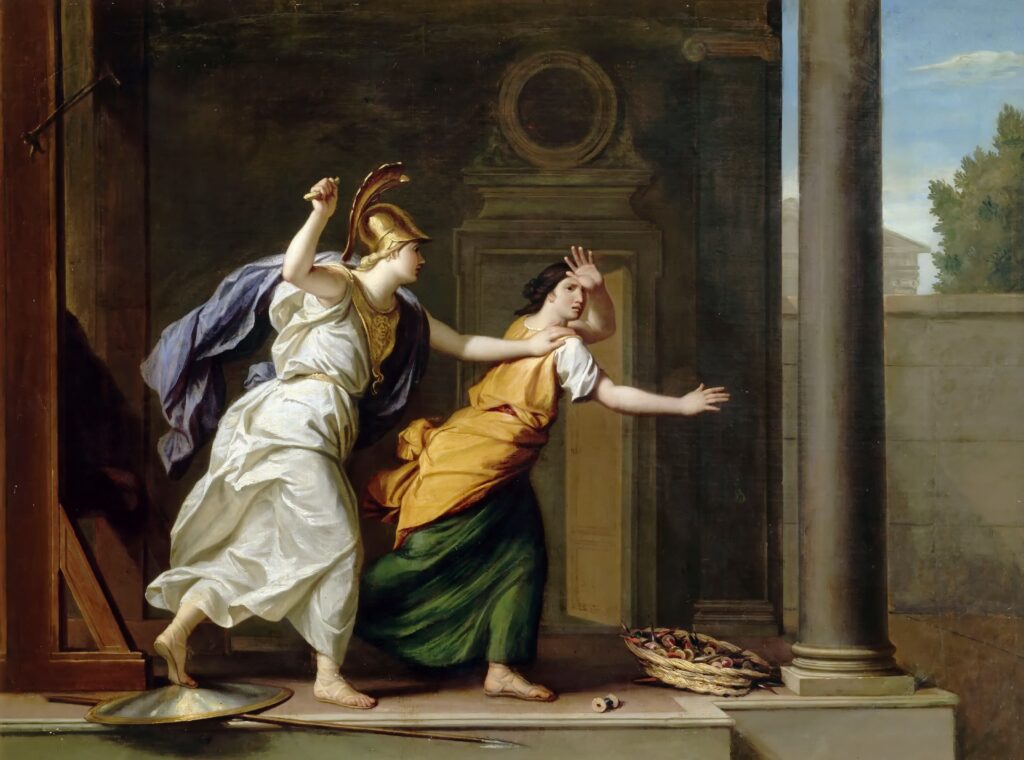
We often associate Arachne with the spider, but this mythological figure has a rich history that extends far beyond our modern-day connotations. Despite its enduring presence in literature and art, Arachne remains somewhat of an enigma, shrouded in mystery and intrigue.
A Brief History of Arachne
The story of Arachne begins with Ovid’s Metamorphoses, where we are introduced to a young woman named Arachne, daughter of a dyer named Idmone. She lives in Lydia, in the city of Colophon, famous for its purple dye. As a child, she shows exceptional skill in weaving and embroidery, creating beautiful works of art that evoke strong emotions and seem to come alive.
According to Ovid’s account, Arachne was so skilled at her craft that she began to challenge the gods themselves, claiming that even Athena wouldn’t be able to weave a better tapestry. This bold statement sparks a challenge between the two women, with Athena accepting the wager and transforming into an old woman to try and convince Arachne to retract her statement.
The Challenge between Arachne and Athena
As the competition begins, we learn more about Arachne’s character and motivations. She is confident in her abilities and refuses to back down, even when faced with the goddess Athena’s transformation. The two women work tirelessly on their respective tapestries, each trying to outdo the other.
Athena’s tapestry depicts the gods and goddesses of Olympus, while Arachne’s tapestry showcases the loves and flaws of both mortals and deities. In the end, it becomes clear that Arachne’s tapestry is superior, showcasing a level of skill and artistry that surpasses even Athena’s own exploits.
Athena’s Punishment
But despite her defeat, Arachne is not willing to show her humility publicly. Instead, she flees, seeking to hang herself from a tree. However, Athena is not willing to let this happen easily, and invents a punishment tailored specifically for Arachne: forcing her to weave for the rest of her days and hang from the same tree where she had intended to take her own life.
As we read through Ovid’s account, it becomes clear that Arachne’s fate is sealed. Her pride and arrogance have led her down a path of destruction, and now she must face the consequences of her actions. The transformation into a spider serves as a punishment for her refusal to show humility, but also highlights the intricate relationships between humans, nature, and the natural world.
The Metamorphosis
And finally, we come to the worst part of the punishment: Arachne would have been better off hanging with her hands rather than her mouth, as she would have become a giant spider. This cruel fate serves as a reminder of Arachne’s pride and arrogance, which ultimately led to her downfall.
This mythological transformation has captivated artists and writers for centuries, inspiring some of the most iconic works in literature and art. The image of a woman transformed into a spider has become synonymous with feminine power and creativity, yet also serves as a cautionary tale about the dangers of hubris.
Arachne in Literature: A Cross-Cultural Phenomenon
The story of Arachne has been retold and reinterpreted across cultures and centuries, from Ovid’s Metamorphoses to Virgil’s Georgics, Dante’s Inferno, and beyond. In Swiss author Jeremias Gotthelf’s short novel “The Black Spider,” we find a unique blend of Greek myth and popular tradition.
A Modern Reinterpretation
But what can we learn from Arachne’s story in today’s world? On one hand, her pride and arrogance lead to her downfall, serving as a reminder of the dangers of hubris. On the other hand, her exceptional skill and creativity inspire awe and admiration. As we navigate our own complex world, we would do well to remember the lessons of Arachne.
We can learn from Arachne’s story in many ways. First, we see the importance of humility and self-awareness in the face of adversity. Despite her exceptional abilities, Arachne refuses to back down, even when faced with overwhelming odds. This refusal ultimately leads to her downfall, serving as a cautionary tale about the dangers of pride.
At the same time, we see the value of creativity and artistic expression. Arachne’s tapestry is a masterpiece of artistry, showcasing a level of skill and imagination that inspires awe. We would do well to remember the importance of embracing our own talents and passions, while also being mindful of the consequences of our actions.
Conclusion
The story of Arachne is a timeless tale of pride, ambition, and redemption. Whether seen as a cautionary myth or a symbol of female empowerment, it continues to captivate audiences around the world. As we explore this fascinating narrative, we are reminded of the power of art and imagination to shape our understanding of ourselves and the world around us.
Frequently Asked Questions
-
Who is Arachne in literature?
Arachne is a mythological figure who appears in various works of literature, including Ovid’s Metamorphoses and Virgil’s Georgics. She is often depicted as a young woman who challenges the goddess Athena to a weaving competition. -
What is the significance of Arachne’s story?
Arachne’s story serves as a cautionary tale about the dangers of pride and arrogance, as well as a symbol of female empowerment and creativity. -
How does Arachne relate to modern-day themes?
Arachne’s story can be seen as a metaphor for the challenges we face in today’s world, including the struggle for self-expression and recognition. -
What is the connection between Arachne and spiders?
The transformation of Arachne into a giant spider serves as a punishment for her pride and arrogance, but also highlights the intricate relationships between humans, nature, and the natural world. -
How has Arachne’s story been retold across cultures?
Arachne’s story has been adapted and reinterpreted in various works of literature, art, and popular culture, reflecting different cultural and historical contexts. -
What can we learn from Arachne’s character?
Arachne’s exceptional skill and creativity serve as a reminder of the importance of embracing our own talents and passions, while also being mindful of the consequences of our actions. -
How has Arachne been represented in popular culture?
Arachne has appeared in various forms of media, including literature, art, film, and television, often as a symbol of female power and creativity. -
What is the significance of Athena’s role in Arachne’s story?
Athena serves as both a foil to Arachne and a symbol of feminine authority, highlighting the complex relationships between women and the natural world.
Further Reading
For those interested in learning more about Arachne’s story, we recommend the following works:
- Ovid, Metamorphoses (translated by Anthony S. Kline)
- Virgil, Georgics (translated by Robert Fagles)
- Jeremias Gotthelf, “The Black Spider” (translated by Donald A. Walker)
We hope that this exploration of Arachne’s story has provided a deeper understanding of this fascinating mythological figure and her enduring presence in literature and art. Whether seen as a cautionary tale or a symbol of female empowerment, Arachne continues to captivate audiences around the world, serving as a reminder of the power of art and imagination to shape our understanding of ourselves and the world around us.


