
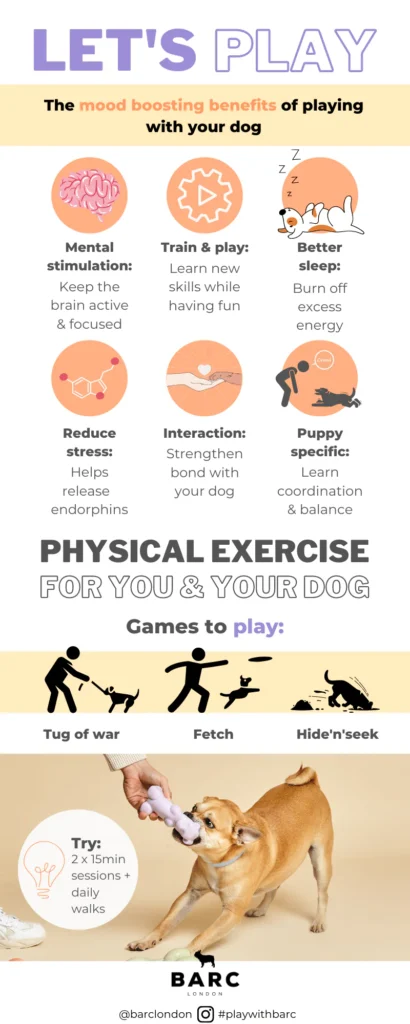
The Importance of Play for a Puppy
Play is essential for the emotional well-being of your puppy. Through play, puppies learn to communicate and interact with other dogs and humans.
Social Development through Play
Play plays a crucial role in the development of your puppy’s social skills, helping them understand social cues and build positive relationships. Socialization is a critical aspect of a puppy’s life, and play helps to create opportunities for interaction with people, animals, and environments that are new and exciting.
Puppies need to learn how to interact with other dogs and humans in order to develop the necessary social skills to live successfully as an adult dog. Play provides them with these opportunities, helping them to understand boundaries, rules, and appropriate behavior.
Mental and Physical Stimulation
Play is not just fun, but also an essential exercise for a puppy’s mind and body. Through various types of play, your puppy can exercise their intelligence, improve coordination, and maintain good physical fitness. Puzzle toys or interactive games are particularly useful in stimulating your puppy’s mind, keeping it active and sharp.
Puppies need mental stimulation to prevent boredom and destructive behavior. Engaging your puppy in play helps to burn off excess energy and provides them with a healthy outlet for their natural instincts. Physical exercise is also essential for maintaining good health, and play provides an opportunity for your puppy to get the physical activity they need.
Positive Behavior Reinforcement
Use play to reinforce positive behavior. By incorporating training into playful activities, you can teach your puppy basic commands in a fun and engaging way. This approach strengthens the bond between you and your puppy, making learning an enjoyable experience for both of you.
Training is an essential part of raising a well-behaved dog, but it doesn’t have to be boring or stressful. By incorporating play into training sessions, you can make learning more enjoyable and interactive. Positive reinforcement techniques are particularly effective in creating a positive association with behavior, making it more likely to occur in the future.
If you want to learn more about how to educate your puppy, consult with a veterinarian behavioralist or a canine trainer who can guide you on how to transform certain training stages into playful moments.
Prevention of Behavioral Problems
Play helps prevent the development of unwanted behaviors. A puppy that receives adequate physical and mental stimulation is less likely to develop problems such as destroying household items or hyperactivity. Play satisfies many natural needs of puppies, including exploration, hunting, and play.
Puppies are naturally curious animals, and they need opportunities for exploration and discovery in order to develop their problem-solving skills. Play provides them with these opportunities, helping them to learn how to navigate the world around them in a safe and controlled environment.
Play also helps to reduce stress and anxiety in puppies, which can lead to behavioral problems such as barking, whining, or destructive behavior. By providing your puppy with adequate playtime and mental stimulation, you can help to create a calm and relaxed state of mind.
5 Ways to Play with Your Puppy
Playing with your puppy is not just about having fun; it’s also essential for their development. Here are five ways to engage in playful activities with your puppy:
- Fetch Games: Playing fetch can improve coordination and physical fitness.
- Hide-and-Seek Games: This type of game stimulates the puppy’s intelligence and encourages problem-solving skills.
- Tug-of-War Games: Tug-of-war games are a fun way to strengthen the jaw muscles and teeth.
- Obstacle Courses: Creating an obstacle course can provide mental stimulation and physical exercise.
- Sensory Play: Engage your puppy’s senses with sensory play, such as hide-and-seek or scent work.
Playful activities help you bond with your puppy and promote their overall well-being. Spend time each day engaging in playful activities with your puppy to strengthen the special bond between you and your pet.
Unappetizing Games for Puppies
Puppies have individual preferences when it comes to play, but there are certain types of games that are not popular among them. Here are some examples:
- Aggressive Play: Playing too aggressively or loudly can be stressful for puppies.
- Overly Challenging Games: Games that are too complicated or frustrating for the puppy can lead to frustration.
- Restrictive Games: Games that limit the puppy’s movement, such as keeping them still or cooped up in a small space, can be uncomfortable.
Understanding your puppy’s preferences and limitations is key to creating a fun and enjoyable play experience. Be sure to choose games that are safe, suitable for their age, and promote a positive environment.
Conclusion
Play is an essential part of a puppy’s development, helping them build social skills, exercise their minds, and strengthen their bond with you. By incorporating playful activities into your daily routine, you can create a lifelong friendship between you and your puppy. Don’t underestimate the importance of play in your puppy’s life; it’s essential for creating a happy, healthy, and well-adjusted companion.
Recommendations
Here are some recommendations to help you get started with playing with your puppy:
- Start with short sessions: Begin with short play sessions (5-10 minutes) and gradually increase the duration as your puppy becomes more engaged.
- Observe your puppy’s preferences: Watch your puppy’s body language and behavior to determine their interests and limitations.
- Be creative: Use various toys, games, and environments to keep playtime engaging and fun for your puppy.
- Involve the whole family: Make playing with your puppy a family activity to strengthen bonds and create shared memories.
By following these recommendations and incorporating playful activities into your daily routine, you can help your puppy develop into a happy, healthy, and well-adjusted companion. Remember, play is an essential part of a puppy’s life, and it’s up to you to provide them with the mental and physical stimulation they need to thrive.


