
As you may have heard people talking about artesian wells and freatic wells, but what’s the difference between them? I’m guessing not many of us ask ourselves this question, as understanding it requires a certain level of technical expertise. Without pretending to be experts or trying to replace professionals who make a living from this, let’s try to explain how these wells are made, their characteristics, and what they’re used for.
To start getting an idea of what we’re talking about, let’s define freatic wells first. A freatic well is essentially a large-diameter well lined with stone or concrete rings stacked on top of each other. Now, let’s talk about artesian wells. They have much smaller diameters and are drilled using a drill bit.
From an hydrogeological standpoint, it’s not the perfect way to define them, but they’re certainly two different types of wells that shouldn’t be confused with each other.
What is an Artesian Well?
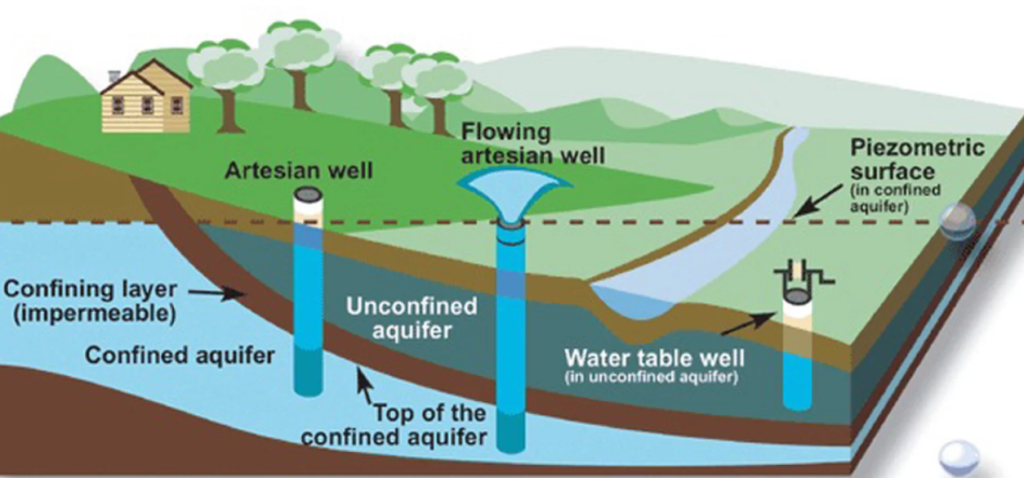
In this article, we’ll focus on artesian wells. An artesian well is a well where water flows naturally without the aid of mechanical devices such as submersible pumps. It’s like human ingenuity, in the positive sense of the word! These wells tap into an underground aquifer called artesian, which is essentially a layer of water at a certain depth. The flow of water is due to the pressure exerted by two impermeable layers that bound the aquifer above and below.
The concept of an artesian well can be understood using simple diagrams or even analogies. Imagine a bucket of water hanging from a rope, with one end attached to a container full of sand, and the other end hanging over a large depression in the ground. If you drop the bucket into the depression, it will hang down until its weight is balanced by the pressure exerted on the water at the bottom of the well.
The same principle applies to an artesian well: there’s a column of water that’s under pressure due to gravity. This pressure pushes water up from the aquifer through the well, creating a continuous flow without needing any external mechanical aid.
What Does an Artesian Well Serve?
Now that we’ve seen how these wells are made, let’s talk about what they’re used for. We know that in some cases, water can rise on its own to a certain level, at least until it reaches the “piezometric line,” which is the point where the water pressure is zero. That’s when artesian wells come into play. These small-diameter wells are designed to tap into the upper part of the aquifer and bring water up to the surface, making sure it can flow freely.
Think of them as helping water find its “last mile” so it can emerge onto the surface. Everything is calculated, everything must be calculated on a case-by-case basis because the rise of water in the aquifer is influenced by pressure within the aquifer itself. When water rises to the surface with ease, it’s easier if there’s high pressure in the aquifer.
Artesian Wells vs. Freatic Wells
Let’s go back to the difference between artesian and freatic wells. We previously said that the diameter is the main distinguishing feature, but that’s not entirely correct. Neither are the construction methods nor the depth of drilling. The real difference lies in the characteristics of the aquifer they tap into.
Let’s break it down better. When you’re trying to get water from a confined space between two impermeable layers of soil, you have an artesian well. On the other hand, if there are porous rocks and water flows uniformly throughout the soil, that’s when you have a freatic well.
The diameter and characteristics mentioned earlier are just secondary consequences of this distinction. Now we can define what it means to have a large-diameter or small-diameter well more accurately. A large-diameter well is one that doesn’t exceed 10-20 meters in depth and is used to capture shallow water sources. Small-diameter wells, on the other hand, can go even deeper, up to 100 meters, because they’re designed to reach the aquifer.
Building an Artesian Well Yourself
Building an artesian well yourself requires specialized equipment but also a deep understanding of the techniques involved and the characteristics your well should have based on where it will be built.
Let’s break down how you’d go about building one:
First, you’d do a trial hole to identify the aquifer. You’d use a drilling machine equipped with a toothed bit that can drill through even hard rocks. As soon as air starts rising from the hole, so does the useful material, like soil, which helps you evaluate the stratigraphy and choose the right equipment for your well.
In most cases, you’ll use a trivellating machine with a toothed bit capable of drilling into rock. While digging, you’d pump in bentonite mud to keep the walls of the well from collapsing. When you reach the aquifer in the trial hole, you’d insert a pipe to complete the job.
To ensure that water doesn’t leak into the well from the surface, you’d put cement in the interstitial space between the pipe and the wall of the trial hole on one side, and siliceous gravel on the other, as well as sealant in the pipe itself. The final step would be to purge the well by removing the bentonite mud and inserting a submersible pump.
Cost of an Artesian Well
It’s difficult to estimate the cost of building an artesian well without knowing the composition of the soil, materials used, and depth of digging required. Prices can vary depending on the company or region you’re in. Here are some rough estimates that should only be taken as indicative:
- A shallow well might cost anywhere from $2,000 to $3,000, assuming there aren’t any complications with the soil and minimal bureaucracy.
- However, if it’s necessary to dig deeper or handle particularly hard rock, prices can rise significantly. In extreme cases, a trivellating operation can cost as much as 90 euros per meter.
It’s also worth noting that building an artesian well requires specialized expertise, and attempting to build one yourself could lead to serious safety risks, costly mistakes, and even environmental damage. If you’re considering drilling a well for water, it’s highly recommended to hire a professional to ensure that the job is done correctly and safely.
Conclusion
In conclusion, artesian wells are an important source of clean drinking water in many parts of the world, particularly where traditional water sources are scarce or unreliable. By understanding how these wells work and what they’re used for, we can better appreciate their importance and value.
Whether you’re a homeowner looking to drill a well, a farmer seeking a reliable source of irrigation water, or an environmentalist working to protect our planet’s precious resources, it’s essential to have a basic understanding of artesian wells. With this knowledge, you’ll be able to make informed decisions about your water needs and contribute to a more sustainable future for all.
Do you have any questions about artesian wells?


