
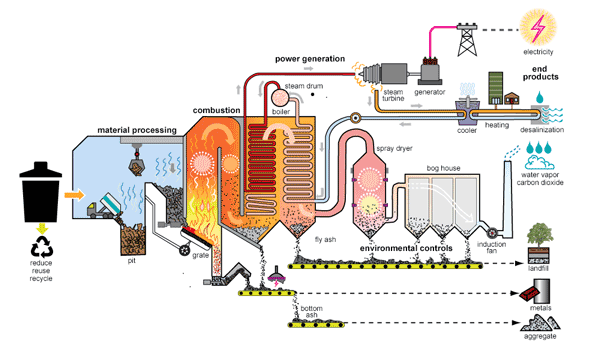
Is waste a source of clean energy? While in Naples, a technology has been developed to harness a “waste-eating” battery, in the United States, 2400 landfills produce their waste for the production of clean energy. Of course, solar and wind power remain the most attractive renewable sources, but even garbage wants its share! The concept may seem unusual at first glance, but it is a growing reality that waste can be converted into energy.
The technology that enables the conversion of waste into energy is now mature. In the United States, over 500 active plants exist, and an equal number of sites waiting to become energy-producing facilities by converting gases extracted from waste into electricity. A significant environmental benefit for the environment every year, which must dispose or stock tons of garbage emitting CO2 and at the same time producing electricity and other products destined to become garbage!
The History of Waste-to-Energy Technology
The recovery of gas from landfills was a reality as far back as 1975, thanks to the work of Jean Bogner, Nobel Peace Prize winner in 2007 and geochemist at the University of Illinois, Chicago. Compared to biomass energy that could potentially yield €16 billion in Italy, waste urban waste has a significant advantage: an existing good system for collection of waste.
When we talk about “waste gases” from landfills, we refer to methane, generated by the decomposition of organic materials in solid urban waste: food scraps, garden waste, leaves, herbs, wood, paper… such gas represents approximately one quarter of total anthropogenic emissions. Not only in the United States, but also in Germany, there are facilities for treating waste, and Italy even pays Germany to export its own waste, which is then transformed into energy by German plants.
The Benefits of Waste-to-Energy Technology
Using waste as an energy source has several benefits. Firstly, it reduces greenhouse gas emissions by replacing fossil fuels with renewable energy sources. Secondly, it creates new economic opportunities for industries and businesses that can benefit from the sale of electricity generated from waste. Thirdly, it provides a reliable source of energy for communities in remote areas where access to traditional energy sources is limited.
Furthermore, waste-to-energy technology has become increasingly efficient over the years. Modern plants use advanced technologies such as gas treatment and carbon capture systems to minimize emissions and maximize efficiency. Additionally, many waste-to-energy plants are designed to be self-sustaining, with built-in energy storage systems that allow them to generate electricity even during periods of low demand.
Rethinking Garbage: The Hidden Value
The value of waste should be reevaluated beyond traditional recycling operations. Waste has a significant value in the energy sector. How does energy come from waste? The gas extracted from landfills is used as a substitute for fossil fuels through a combustion process that produces carbon dioxide and water.
It’s necessary to use the gases produced by landfills for energy production, otherwise they could harm the environment: methane traps heat 23 times more than CO2, warming the earth. If collected, this gas can fuel industrial boilers or start turbines capable of generating electricity.
Using gas to power a turbine to generate electricity might seem an inconvenient solution due to high costs, but remember that there are many cars running on methane, so such gas could undergo compression or liquefaction for use in vehicles or be directed directly into the pipes leading to homes. A limitation of methane produced from waste is its purity: if not treated, it’s rich in impurities that make it less appealing to a mass market.
Challenges and Limitations
While waste-to-energy technology has many benefits, there are also challenges and limitations associated with it. One of the main challenges is the high upfront cost of building new plants. Additionally, the process of extracting gases from landfills can be slow and labor-intensive, requiring large amounts of equipment and personnel.
Another challenge is the management of waste streams, particularly in urban areas where waste is often generated in large quantities and has complex composition. Furthermore, waste-to-energy plants require specialized equipment and maintenance to ensure efficient operation and minimize emissions.
Conclusion
While renewable energy sources like solar and wind power remain the most promising options, garbage must also be considered as a source of clean energy. The technology for converting waste into energy is now well-established, with over 500 active plants in the United States and numerous sites awaiting activation.
The potential benefits of using waste to generate electricity are significant, not only for the environment but also for the economy. By harnessing the energy from waste, we can reduce greenhouse gas emissions and create new opportunities for industries and businesses.
Frequently Asked Questions
Q: Can waste be used as a source of clean energy?
A: Yes, waste can be used to generate electricity through the recovery of gases extracted from landfills.
Q: How does the process work?
A: The gas is extracted using aspirators, then converted into a combustible material through an oxidation process that produces carbon dioxide and water.
Q: What are the benefits of using waste energy?
A: Using waste as an energy source reduces greenhouse gas emissions and creates new economic opportunities for industries and businesses.
Q: Can methane from landfills be used to power vehicles?
A: Yes, methane can be compressed or liquefied for use in vehicles or directed into home pipes.
Q: Is the purity of methane a limitation?
A: Yes, if not treated, methane is rich in impurities that make it less appealing to a mass market.
Q: What’s the current state of waste-to-energy technology?
A: Over 500 active plants exist in the United States and numerous sites await activation.
Q: Can we rely on waste as a renewable energy source?
A: While not yet a primary source, waste can be an important complement to other renewable energy sources.
Case Studies
There are several case studies that demonstrate the effectiveness of waste-to-energy technology. For example, in the city of Baltimore, Maryland, a 10-megawatt landfill gas power plant was built using methane extracted from the city’s waste management facilities. The plant provides electricity to over 20,000 homes and reduces greenhouse gas emissions by an estimated 100,000 tons per year.
Another example is the Waste-to-Energy Plant in London, which uses anaerobic digestion to convert food waste into biogas, which is then used to power vehicles and heat buildings. The plant has reduced greenhouse gas emissions by over 50% and provides a reliable source of energy for the local community.
Future Developments
As the technology continues to evolve, we can expect to see more efficient and cost-effective waste-to-energy plants built in the future. One area of focus will be on improving gas treatment systems to minimize emissions and maximize efficiency.
Additionally, researchers are exploring new technologies such as microbial fuel cells that use microorganisms to break down organic matter into biogas, providing a more sustainable and efficient source of energy.
Conclusion
The use of waste as a source of clean energy is an innovative solution that has the potential to transform the way we think about waste management. By harnessing the energy from waste, we can reduce greenhouse gas emissions, create new economic opportunities, and provide a reliable source of energy for communities around the world.
As the technology continues to evolve, it is essential to support research and development in this field, as well as to encourage policy makers to adopt supportive regulations that allow waste-to-energy plants to thrive. Together, we can build a more sustainable future powered by waste.


