
Introduction
As we strive to create a more sustainable future, the European Union (EU) is taking significant steps towards promoting environmentally friendly agricultural practices. In this article, we will delve into the concept of sustainable agriculture in the EU, exploring its key components and what it means for our planet.
The EU has set ambitious goals to become climate neutral by 2050, and sustainable agriculture plays a crucial role in achieving these objectives. The European Commission’s Green Deal aims to make Europe the world leader in sustainable development, and the agricultural sector is at the forefront of this effort. In this article, we will examine the concept of sustainable agriculture in the EU, its benefits, and what it means for our future.
What is Sustainable Agriculture?
Sustainable agriculture is an approach that aims to balance economic, social, and environmental considerations in farming practices. It involves using environmentally friendly methods to produce food while minimizing harm to the environment. Sustainable agriculture is not just about producing more food; it’s also about ensuring that the food we eat is produced in a way that respects the planet’s resources and promotes biodiversity.
Sustainable agriculture can be achieved through various means, including:
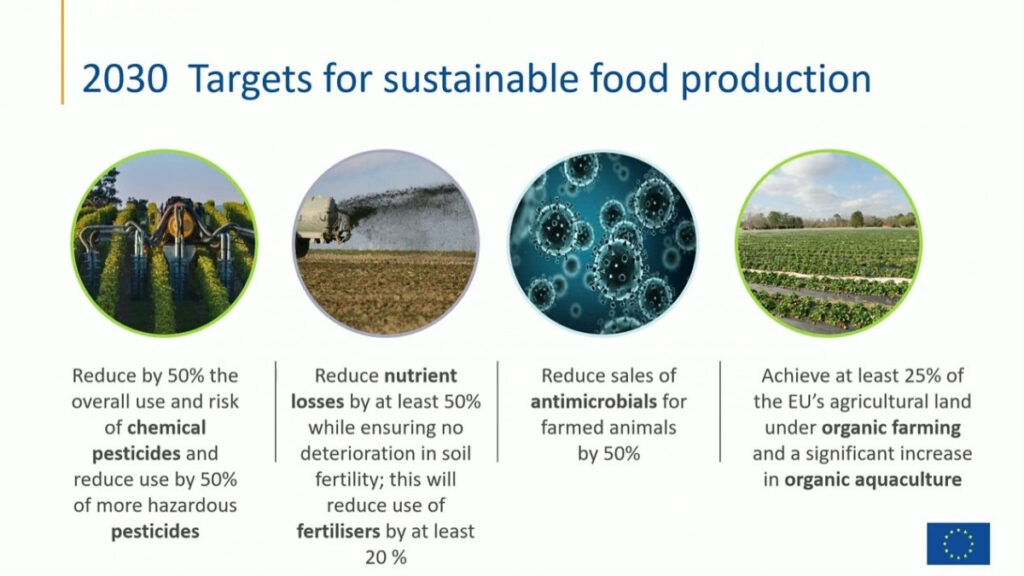
- Organic farming: Organic farming avoids the use of synthetic fertilizers, pesticides, and genetically modified organisms (GMOs). Instead, it relies on natural methods to control pests and diseases.
- Agroecology: Agroecology is an approach that emphasizes the importance of ecological interactions between plants, animals, microorganisms, and humans in farming systems.
- Integrated Pest Management (IPM): IPM involves using a combination of techniques, such as crop rotation, biological control, and cultural controls, to manage pests without resorting to chemical pesticides.
A Proposal from the Green Economy Council
The Italian Presidency of the EU Council has submitted proposals for sustainable agriculture to the government. One of these proposals includes the creation of a European transparent label, which will provide accurate and relevant information for businesses. This label will cover various aspects, such as:
- Origin of raw materials: The origin of raw materials used in food production, including where they are sourced and how they were produced.
- Nutritional guidelines: Nutritional information about the food product, including its nutritional content and any health claims.
The Green Economy Council also emphasizes the importance of Denominations of Origin (DO), ‘Products of the Mountains’ (DOP), and ‘Farm Products’ (PGI). They advocate for the acceleration of EU Regulation 1151/2012, which simplifies procedures and promotes international protection of high-quality certified products.
Denominations of Origin and Traditional Products
The Green Economy Council stresses the significance of Denominations of Origin (DO), ‘Products of the Mountains’ (DOP), and ‘Farm Products’ (PGI). They advocate for the acceleration of EU Regulation 1151/2012, which simplifies procedures and promotes international protection of high-quality certified products.
- Denominations of Origin (DO): DO is a certification that guarantees the origin of raw materials or food products. It ensures that products meet specific quality standards and are produced in accordance with traditional methods.
- ‘Products of the Mountains’ (DOP): DOP is a type of Denomination of Origin that emphasizes the geographical origin of products. It’s often used for dairy products, such as cheese and butter.
- ‘Farm Products’ (PGI): PGI is another type of Denomination of Origin that ensures the quality of food products. It’s often used for meat and poultry products.
Environmental Impact Assessment
Another crucial aspect of sustainable agriculture is the development of methods to calculate environmental impacts. The proposed methodology should be simple, flexible, and responsive to the needs of a circular economy. This approach will benefit both small and medium-sized agricultural enterprises (SMEs) and large-scale farmers.
The Green Economy Council suggests that each member state should have the freedom to choose its own food policy strategy. This means that countries can decide whether or not to allow genetically modified organisms (GMOs). By giving states sovereignty, we promote diversity and adaptability in agricultural practices.
Sovereignty in Food Policy
The Green Economy Council suggests that each member state should have the freedom to choose its own food policy strategy. This means that countries can decide whether or not to allow genetically modified organisms (GMOs). By giving states sovereignty, we promote diversity and adaptability in agricultural practices.
A Comprehensive Approach
The document outlines six pragmatic proposals for EU policies: fiscal ecology, climate and energy, sustainable agriculture, water resources, waste management, growth, and green occupation. These proposals demonstrate a comprehensive approach to addressing the challenges of our time.
- Fiscal Ecology: This policy aims to reduce greenhouse gas emissions from agricultural activities by promoting sustainable practices.
- Climate and Energy: This policy focuses on reducing energy consumption in agriculture and transitioning to renewable energy sources.
- Sustainable Agriculture: This policy promotes environmentally friendly farming practices, such as organic farming and agroecology.
- Water Resources: This policy aims to conserve water resources and promote efficient irrigation systems.
- Waste Management: This policy focuses on reducing waste in agriculture by promoting recycling and composting.
- Growth: This policy promotes sustainable economic growth by supporting small and medium-sized enterprises (SMEs).
- Green Occupation: This policy aims to create jobs in the green sector by training workers in renewable energy technologies.
Why Now?
With the current Italian presidency of the EU Council, we have an opportunity to shape EU policies and give them a distinctly Italian character. This is a unique chance for us to make a difference in creating a greener future for Europe.
The Green Economy Council’s proposals offer a comprehensive approach to sustainable agriculture, promoting environmentally friendly practices, reducing greenhouse gas emissions, and supporting small and medium-sized enterprises (SMEs). By adopting these proposals, we can create a greener, healthier food system that benefits both people and the planet.


